published : 02/26/2026
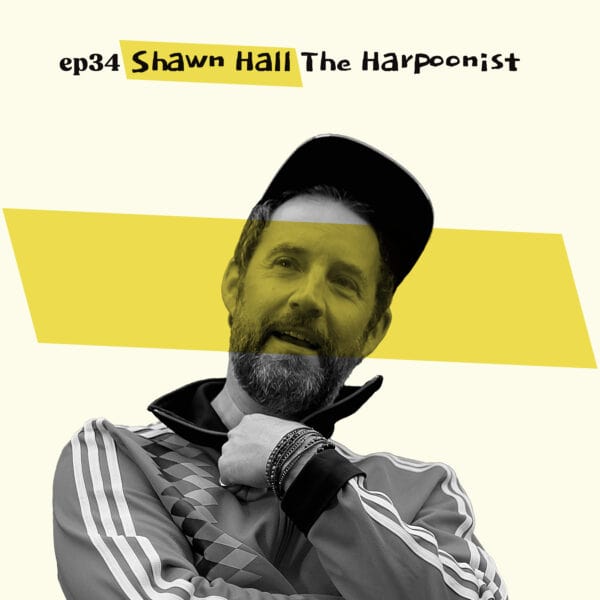
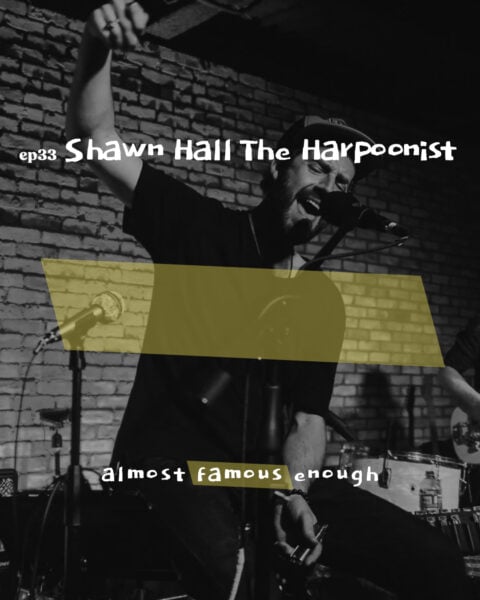
In this conversation, Shawn Hall opens up about his recent creative transformation – recording a solo album under his real name in Paris with legendary producer Renaud Letang (Feist, Manu Chao, Son Little). He discusses the vulnerability of stripping away his “superhero moniker,” the challenges of being pushed outside his comfort zone, and what it means to evolve as an artist two decades into a career.
Award-winning blues artist Shawn Hall (The Harpoonist) joins Glen for a candid conversation about reinvention nearly two decades into his career. From gritty breakout moments to recording a vulnerable new solo album in Paris under his own name, Shawn reflects on identity, creative risk, and stripping his music down to its emotional core. It’s a deep dive into growth, longevity, and what happens when you step outside your comfort zone to rediscover your voice.
ep34 Shawn Hall The Harpoonist
released February 26, 2026
2:02:53
Key Topics Discussed
“I wanted to be an outsider again.”
Guest website: https://theharpoonist.bandcamp.com/track/good-people
Guest Instagram: https://www.instagram.com/the_harpoonist/
Guest Youtube: https://www.youtube.com/@theharpoonistshawn
hosts: Glen Erickson, Alexi Erickson
Almost Famous Enough website: https://www.almostfamousenough.com
AFE instagram: https://www.instagram.com/almostfamousenough
Almost Famous Enough Spotify playlist: https://open.spotify.com/playlist/1o1PRD2X0i3Otmpn8vi2zP?si=1ece497360564480
Almost Famous Enough is a series of conversations centered around the music industry, pulling back the veil on what it really means to “make it”. Our podcast features guests who know the grind, who have lived the dream, or at the very least, chased the dream. Through these conversational biographies, truth and vulnerability provide more than a topical roadmap or compile some career advice; they can appeal to the dreamer in us all, with stories that can teach us, inspire us, and even reconcile us, and make us feel like we made a new friend along the way.
Chapters
00:00 Introduction
03:11 Island Life Talk
12:35 Paris Reset Record
27:10 Vulnerability In Studio
41:55 Origins Of The Harpoonist
46:34 Trailblazing Blues Identity
49:00 Banter Versus Gatekeeping
53:16 BreakOut West Buzz
01:06:31 Duo Mechanics Trance
01:11:06 Harmonica Style And Gear
01:27:00 Solo Records And Longevity
01:29:58 New Songs Not Nostalgia
01:33:16 A Regina Memory
01:35:32 Winter Wrap Up
01:37:29 Post-Fame with Alexi
ep34 – Shawn Hall The Harpoonist
[00:00:00] You know, not surprising, but the older I get, the more I understand how nuanced everything is. Things just aren’t black and white. It is such a key method of understanding the world through our very foundational stages of early development, making everything binary, either bad or good. If I am this, then I can’t also be that and so on.
It doesn’t just go away. When we achieve intellectual and emotional maturity, it lingers with us some more than others in different ways. And I think on this podcast, the more we talk about life as an artist, a creative, as well as talking about who we are and how we become this way. Well, it becomes more clear to me how important it is to understand how nuanced everything is.
Take Shawn Hall for example, he has gone by the moniker of the Harus for most of his life, and thereby known for the skilled [00:01:00] harmonica playing, which is couched in the blues genre. Both things immediately binary for much of the regular public. The blues is the blues, the blues harmonica. It’s played a certain way.
But then you realize Shawn Hall sees himself a bit different, his harmonica as the self-professed punctuation between his vocal expression, but not compartmentalized, woven, which as you hear him tell his story of approaching his latest songwriting and recording efforts as a creative blank canvas becomes even more tangible to his entire creative approach.
Make nothing binary. Not accepting the limitation of his approach to getting sounds out of an instrument any more than accepting the limitations of how geography, history, partnerships woven with the pride or humility and optimism can impact what he gets out of him [00:02:00] himself and what it creates for his life.
Shawn Hall is an award-winning Juno nominated harmonica, playing vocalist and songwriter out of Nanai, BC Canada. You know, for the better part of the last 20 years as the Har Pist, one half of the Blues duo, the Har Pist and the Ax Murderer, clever born in England, unlikely origin story, already moved to Toronto very young, and eventually to Vancouver in his young adult years where the partnership was formed.
The past two years have found him pursuing solo efforts, chasing growth, and wider opportunities as he continues to shape his career now almost two decades in embracing the nuance, getting comfortable with being where his harmonica lives in the in-between at times. My name is Glen Erickson. This is Almost Famous Enough.
Thanks for spending your time with us. This [00:03:00] is Shawn Hall.
Glen Erickson: Everybody knows it’s not formal press. sweet. thanks Shawn for joining me. Uh, Shawn Hall, the harpoonist you just asked. I’m up in Edmonton. I am, I’m in the cold north. Are you in Nanaimo,
Shawn Hall: Yes, I am. I am sir.
Glen Erickson: what part of Nanaimo, whether you’re sort of in the newer north or in the old city
Shawn Hall: I am in the old city.
Glen Erickson: to the,
Shawn Hall: old city man. Yeah. I’ve been in the old city for, for 13 or 14 years.
Glen Erickson: Okay, beautiful. Yeah, I love it down there so much. Sometimes for work, we have to fly into Victoria first and then sometimes they wanna change the flights around. I’m like, no man, I want to make that drive. ’cause I just love even the drive and taking my time up that drive from Victoria to Nanaimo. And especially if [00:04:00] the fog is just clearing as you drive, it’s like so perfect.
It’s like
Shawn Hall: Yeah. So it’s
Glen Erickson: little magical. More people in Canada should know just how magical the island is
Shawn Hall: Yeah. There’s, there’s commutes and there’s, there’s commutes, and not all commutes are, are, are equal in this country.
Glen Erickson: It’s a hundred percent true. Okay, so you’re on the island 13, 14 years you said.
Shawn Hall: 13 to 14 years. He got it. Yeah.
Glen Erickson: Okay. So a couple things there for me. Like, do you consider yourself like a real islander? And by that I mean
Shawn Hall: Huh.
Glen Erickson: there’s a vibe there. There’s a, uh, it’s equal to like if I go down to like Cuba or some place, and people are sort of like, whether or not you kind of have the flow and the rhythm of like the people, I feel like the Islanders in Canada, like on Vancouver Island have the same rhetoric.
Like I, I go there for work and I got told a few times like, you should move here, Glen, you’ve totally got like, [00:05:00] you’re an islander. And I’m like. I want to know what that means right off the bat, but it seems like a really good thing. Um, so do you feel like you’ve stayed there for so long because you’ve found your, your place and your vibe, or is there sort of that magic woven into your choice to stay?
Shawn Hall: it’s kind of, well, the magic, if you call them magic two kids, um, then kids, kids help kids, kids don’t like to move all over the place. Kids, you
Glen Erickson: a different equation for
Shawn Hall: that’s, that, that’s a different equation. So the music, the music wants you to move where the music moves you. So music doesn’t care about geography, about, anything as we know, right?
It doesn’t, it blurs the lines between the upper class and the middle and the working. It’ll take you anywhere. but the kids have sort of helped gr I would say, ground me throughout all these years of travel. So every time I go out and I spin out into the world and I go, wow, I’m over [00:06:00] here. Um, when I come back after I sort of cool my head and, and dial back into the, uh, the week to week, it’s a pretty far out awesome place to live.
Because we’re not stuck in the grind of everything else. You can get to anything within five to 10 to 15 minutes, I mean anything. Right? You’re not spending
Glen Erickson: Parksville. Qualcomm,
Shawn Hall: Parksville, Qualcomm
Glen Erickson: and, yeah. Yeah.
Shawn Hall: Duncan. You can go up to Cumberland and live in this little music village and go, you know, mountain biking and, and if you’re crazy enough you can dip into their, their, uh, their glacial Fed Lake, you know, in an hour and 15 minutes from my front door.
Glen Erickson: Yeah.
Shawn Hall: that’s pretty amazing.
Glen Erickson: I love that. So I joked about sort of the island vibe and I have some friends who will just, uh, really dumb it all the way down and, and think like a lot of hippies live on the island and, and do that. I don’t think that’s [00:07:00] true from what I’ve seen. my favorite thing, the was the very first time I got to make that drive though, was, years and years ago.
So like in the early days, like when I was first playing music and I was, and basically CBC radio three online was the culture curator of indie music and, and a whole bunch of styles and genres for the country. I felt, you know, like early two thousands, the, the first 10 years of the decade and, And Grant Lawrence had the kind of the anchor afternoon show, and he would always, he has this, uh, cowichan and sweater that someone custom made with the CBC logo and stuff.
And he wore it everywhere for like a decade. Like, it doesn’t matter how hot it was, like July 1st candidate day parties, he was wearing the cowichan and sweater. and we had this great debate, or not really debate, just a conversation once about how, I grew up on the prairies and this sweater. There were lots of them around.
They were itchy, woolly. I didn’t wanna wear them, but they [00:08:00] were the warmest thing ever. And there was always one hanging in somebody’s dad’s closet everywhere I would go in, in the prairies. And they called them swash, which I found out later was actually probably more of a slur or derogatory indigenous. Term, I’d have to look that up a bit more. but in my adulthood, I’ve been told maybe that wasn’t actually a great term, but it was the late eighties. So, but I had never heard the term cowichan, until I heard, you know, grant Lawrence referring to his thing on it. And I only thought it was just another name.
Like some people just, some people call it a hoodie. Some people call it a bunny hug, you know, depending where you are in the
Shawn Hall: Okay. Gotcha. Gotcha.
Glen Erickson: so I thought it was just another term, like this is literally like discovering Ronald McDonald was a clown in your forties or something. I was driving up the highway literally at that intersection for uchin and seeing the big signs.
There’s a McDonald’s on the left, and I’m seeing the huge signs about this way to this, you know, [00:09:00] IMO straight ahead, cowichan in here, and right below the word cowichan is this. Panhandler dude on the corner with the big cardboard sign wearing a big, thick cowichan and sweater underneath the sign. And all of a sudden it all made sense to me.
And I’m like,
Shawn Hall: Yeah, like,
Glen Erickson: I’m, I’m so stupid. This has been 25 years in the making for me or something, but
Shawn Hall: but we can’t all claim to know everything. It’s like, you know, I thought when I first moved west, like 25 years ago, don’t feel bad. I mean, I thought when I moved west from Toronto 25 years ago and I saw people in cowichan and sweaters, I was like, that’s a cowichan and sweater. Then I just thought like, cowichan and sweater is a style of sweater as well, and then I moved to the island.
I’m like, no, the cowichan and people, um, it comes from a long lineage of, of, you know, of this is the tradition
Glen Erickson: People on the island. Yeah,
Shawn Hall: people on the island and people in this particular region of, you know, in dunking and the cowichan and valley and cowichan river. And like, like that’s, it’s a, it’s the cowichan and [00:10:00] people that, where, that, where that tradition comes from.
And not everyone else in the country has that claim, you know? Um, so it’s nice to, it’s nice that there was a billboard and a guy below you, a guy below the, the billboard with the, with the sweaters so
Glen Erickson: like, I, it’s like the universe being like, we’re gonna, we’re gonna make this really clear for you right now, and you better not miss it
Shawn Hall: All right, do
Glen Erickson: to McDonald’s. But, well that’s a great, that’s a beautiful place to be. thanks for joining me to have a conversation. I’ve obviously been aware of your music career under the moniker, the Harpoonist, most of your career in the band, the Harpoonist and the Axe murder.
probably, you can tell me whether this has been your experience. Like a majority of people who quote unquote, I’m air quoting, uh, know you probably only know you as the cowichan, might not have actually. You know, you don’t always find out the actual name of the artist when they have such a, a prominent moniker.
Maybe they don’t even know that you were Shawn Hall for like 10 years or [00:11:00] something. But, but that’s been pretty much your whole career in music as the cowichan. Correct. So, so I, I thought, you know, in, in doing the podcast, like I’m not, I’m, I’m working really hard. I don’t want to be beheld to like the publicity cycles and things like that.
I mean, I get my pitches and there’s, you know, some people, it’s a lot easier to get them on if I wanted to get them on, if they are in the middle of a promotional cycle for album releases or tours or of those kinds of things. So that
Shawn Hall: Yeah.
Glen Erickson: can’t escape the industry. But, uh, I just have a list of people I’ve, from the minute I started doing this, I thought.
These are people I think it would be great to have on people who aren’t all sort of cut from a, an easier middle mainstream, you know, that probably have a story and, and sort of have had experiences outside of what my experiences have been. And you’ve been one of these guys that I’ve thought all along, like, uh, here’s a guy who’s been in the [00:12:00] Canadian music scene for, uh, a good while, kind of doing things that, you know, crossed over my paths here and there, but not directly.
So, um, so this was fun for me. I appreciate it. And, um,
Shawn Hall: I do too, man. You, you hit me up at the right time.
Glen Erickson: I did,
Shawn Hall: Yeah, you hit me up at the right time. I just got back from, from Paris and I’m, I’m home and I’m just doing stuff with my kids and it’s the dead of winter and I’m like, this guy’s tiring. Is is fucking, it’s right on.
Glen Erickson: Good. I’ll just keep, uh, keep trying to stay in that zone.
Shawn Hall: Keep staying in that zone, man.
Glen Erickson: what was Paris? Was that playing? Was it recording?
Shawn Hall: Paris was
Glen Erickson: ask you that before. We’re recording.
Shawn Hall: I was, I had a, I was there for two chunks of time, uh, October, November, and then the last bit was the beginning of January until just like a couple weeks ago. So I was making a record there. Under, under my actual real name. I figured I’ve, I’ve earned it at this point in my life.
To be able to [00:13:00] like make a
Glen Erickson: the release gonna be a Shawn Hall release
Shawn Hall: is gonna be Shawn Hall. If you can’t, if I can’t be me at this point in my life, then I’m screwed. you know, and it’s, and it’s not, uh, it’s not, uh, like sticking with the, let’s just say names are like, you know, these superhero monikers and like the Har Buddhist as being my, that’s my superhero moniker in the, not the blues world, but in the harmonica soul rock and roll blues world, that, that umbrella.
And so I figured this outing in France with a different producer, with a whole different world. It was my time to get out of North America and explore what I’m like, what I can be, uh, creatively outside of North America. And uh, and that’s what I was doing there. And yeah,
Glen Erickson: So there’s a lot there. I don’t really do this a couple, I do this a couple of different ways, but I mostly prefer to just kind of go where the thing leads me. So, um, number one, this is your, [00:14:00] this is your taking off the makeup kiss moment then of,
Shawn Hall: is, sure.
Glen Erickson: you know, we’re gonna try this without the, the, the big steel boots and the, and the makeup on. So that’s pretty exciting. And I, and I, I like that you framed it as like, I mean, you made a joke, but you also said. I’ve maybe earned it. And you know, that’s, I’m gonna guess, is that a scary, is that still come with some version of vulnerability or second guessing? Has it been just an absolute, I’ve been stewing on this for too long to make that decision?
Or is there still a little bit like, I don’t want to completely start over and, and a name is a big a a
Shawn Hall: The name is like, well, the thing is like, uh, boy, it’s, there’s the industry, there’s people’s perception and, and how they know you, you know? And, and Matt and I have been doing the Harpoonist, the Axe murder for, um, pre coming up around, uh, 20 years [00:15:00] this next year. So that’s, that’s, that’s a decent chunk of time for a band that’s, that feels like a hundred years.
Um, and I feel like when I was out in, when I was in France making the record and writing it and coming, together with this, this producer, it’s the same producer that that changed a lot of people’s lives. Like Manu Chow, I don’t know if you remember Clandestino Manu Chow, the early two thousands.
Glen Erickson: Yeah, the name’s familiar. I’m trying to place where it was
Shawn Hall: It was like he, he, he worked with a guy named, uh, Tang, and that’s the guy that’s the producer that I was attracted to work with because he’d had such a profound effect on so many people’s lives, including Feist. Um, he was the guy that, that changed Feist’s trajectory as a, as an artist from a folk singer to a folk pop singer, a Chili Gonzalez, Sue George, Jamie Liddell, uh, son, little. and these are all the people that, that, or some of the people that he worked with. And I decided to, to, uh, just take [00:16:00] myself over there and I said, whatever you wanna do, I trust it’s gonna be the right thing.
We don’t have to do a blues record, a soul reggae, you know, any one particular thing we’re gonna write, we’re going to come up with this stuff fresh and on the spot. And I don’t want to, I didn’t want to be limited. by the perception of what the Haris does, meaning every song I play or every song I write, I need to pick up my harmonica and, and, you know, and that’s, that’s where you end up feeling like a superhero sometime, for better and within limitations, right?
Glen Erickson: Yeah, like your harmonica is your cape and you know, it’s always gotta be there type thing,
Shawn Hall: yeah.
Glen Erickson: So tell me a little bit. About choosing to write songs that way, not knowing what your traditional method of songwriting has been. I mean, this plays into some of my other larger questions I just kind of had about your career, your career as a, you know, a singer, but [00:17:00] a, a harmonica a heart player as much as a singer.
Like that’s kind of what your instrument, but also your signature for lack, I guess lack of a better term would be. Right. And, you know, which to me, like I play guitar, I immediately have a vehicle for writing songs, or if I play piano, I immediately have a very typical vehicle for writing songs. Right.
Like, um, you don’t get as many, you know, violin soloists or trumpeter writing songs or whatever. So the, the more soloist instrument, I guess is what I’m referring to. So what is your. What has been your typical method for songwriting? Has it always been collaborative? Do you just write on your own? Oh, there it is right there.
A mic and a, an old standup piano.
Shawn Hall: There you go.
Glen Erickson: Ha. Have you always pulled the face off of that so you can just hear it or feel it
Shawn Hall: Yeah, so I can, so I can mic it. I’ve got like, um, uh, a reel to reel, uh, quarter inch reel to reel above it. Then I’ve got these two, they’re not on there now, but I, I had these two [00:18:00] old Sony mics that go straight down, nothing fancy. Um, and then right next to it is. A Hammond
Glen Erickson: an old old, an old organ beauty.
Shawn Hall: an old organ. And that’s, and that’s my preferred method.
You don’t write, I don’t know anybody that writes with a harmonica. It’s, it’s, you know, I,
Glen Erickson: Yeah.
Shawn Hall: don’t, I think I tried, you know, 20, 30 years ago, I probably tried. But you don’t, it’s a rhythmic accompanying instrument. It’s a lead instrument. The way that I play it, I always play it. This is how, just as you were talking about, like, you know, this is my cape.
The harmonic is my punctuation. That’s how I see it. It’s, it is my, it’s my exclamation, it’s my rhythmic punctuation in between phrasing as a singer. So there’s a lot of people that see themselves as the solo virtuosos. I’ve never approached it that way because I don’t see my relationship with it that way.
But I see it as a rhythmic punctuation [00:19:00] of, of my vocal, you know, performance. But for the, for the most part, for the last like 10 years, I’ve been writing on the upright piano, um, either by myself or with a buddy of mine down on Cowichan.
Glen Erickson: Yeah. Oh, beauty. Okay, so I’m gonna put, uh. I’m gonna like make a little, whatever you do on the corner of your page, a little earmark or whatever they call that on the conversation about just your approach and your use of the harmonica and sort of your style. ’cause I wanted to ask you some questions about that, so I wanna make sure I come back to that.
But, so what was the different approach this time in Paris? I mean, I really enjoyed that you immediately made the suggestion that the change you needed, or at least the, the size of the change that you felt you needed also maybe required some geography, you know, to kind of create that. And I absolutely love that.
I love that connection to just how many different factors, you know, create the change that we [00:20:00] might need or the inspiration or whatever, you know, whatever it is we’re looking for. So why, why Paris? And how much does geography or the place that you go to create, how, how much does that affect you or, or how’s it traditionally affected you?
Shawn Hall: It, I mean, I would say it depends on the artist that goes to the place and how much they let that geography affect them. And by that I mean how much they actually spend time out of the studio because a lot of people go to studios in far out in wild places. Never leave because of the nature of, of music just being all encompassing and they’re sucked in and then they go to their hotel or Airbnb or wherever the hell they’re staying and then they go to bed.
But I let Paris, I let my experience in Paris affect me in every way possible from cheese and baguettes and all that stereotypical stuff that is life enhancing. It is, you know, it is, it is indeed life enhancing to have espressos and that [00:21:00] level of pastries and, involved with your art. And, um, and, uh, working with a crew, that was all French speaking.
I wanted to be challenged to see if I could actually remember French from my childhood, from school. So I wanted to, so I wanted to not sing in French. ’cause that would be, maybe I’ll be able to, maybe I’ll do that on the, on the next record and do like a song or two. But, but be able to like work and comprehend a bit more in French and to be an outsider again.
and to get outside the comfort zone of like, no one gives a fucking shit about, they don’t know who I am there. And so that was ultimately freeing. They don’t care about, you know, the, you know, Harpoonist. Like, I built a, a, a great life in Canada with an incredible fan base and a, and a great legacy. As you know, we toured forever and ever and ever Matt and I, and, and that that is, is hopefully it’s always gonna stay, um, as rich as it’s being.
But I, I wanted to go to a place where people didn’t give a crap and they were, [00:22:00] and I wanted to see, uh, I, I told them, I said, I’m a tough, I’m a tough dude. And I can take sort of anything you throw at me. but I’m actually not as tough as I, as I thought in hindsight, after, after making the record, I’m a fairly sensitive, but we’re all sensitive, but we have different exteriors.
But, um, but I got tossed around a fair amount and, uh, you know, and, and it, and it made for, it brought out elements to me that I haven’t felt since I was in grade two in choir, to be honest. And since I was going to school and learning how to sing and,
Glen Erickson: What does that mean? Tossed around like they were, like, were they, uh, as specific as, they were, like challenging you just on like
Shawn Hall: challenging me, like
Glen Erickson: musical acumen
Shawn Hall: yeah. Yeah, yeah. Yeah.
Glen Erickson: participate at what level and sort of rotation they’re working in.
Shawn Hall: Yeah. And I kind of, I, I almost purposefully naively understudied, what a guru, that producer in that whole studio. I went to a studio called [00:23:00] Ferber, and it was like the birthplace of disco, French disco and, Sue Gain, s esberg worked there, um, Nina Simone, like on and on and on. And it’s like a legendary institution.
And I did not, I just under studied it so that I could approach it and not be freaked out. But when I started working and they were putting me through the paces of singing, I was like, well, that’s gonna be, I’ll be, I’m a, I’m a decent singer. I, I should be able to cut the mustard. And I had a lot of days where I wasn’t meeting their expectations.
Glen Erickson: Hmm.
Shawn Hall: and, and that stuff was, it’s really good for, it’s really good for you to, to sort to sort of hit that because I, I, you know, I. Come back the next day and then I would, and I would ace it, hopefully. But I had multiple days where, where, um, I would just be pushing, pushed into arenas that I was unfamiliar with, you know.
Glen Erickson: Yeah. that’s, uh, I love that perspective. I think a lot of times maybe we start to [00:24:00] carry this concept of the recording artist, or at least even the accomplished recording artists, right? Like they’ve got a career, they got a discography under their belt so that when they go to make their next record, they’re hiring a producer, they’re paying for the studio time.
There’s this maybe built in entitlement concept of, right, that, that you are the one hiring their services. So then why would you get so freaked out? And they’re putting you through the paces and like you’re trying to measure up to them. But, but you framed it in a perfect way to me, which is like, yeah, you, you had the opportunity, you know, to, to hire a guy.
But the way these things often work is like, you usually have to go and ask. Somebody with like a lot of reputation in that field, if they wanna work with you
Shawn Hall: Yes.
Glen Erickson: and then they do their own due diligence to do some background work and check out and see if it’s a good fit and if the timing works. And if all those things align and they say [00:25:00] yes, then yeah, you’re still like writing them a check for their services at the end of the day.
But they’re, you’re actually, you’re asking them to be the captain of the ship essentially still, even though you’re paying, you’re paying for all of the the ship,
Shawn Hall: It’s, it’s, it’s an interesting dynamic that way. You are paying for that. I mean, I did everything out of pocket for this record, uh, you know, with the hopes that the grant system and everything else follows suit. But I knew it was like, you know, given the, the, these times that we’re living in the unpredictability of, you know, uh, the, the time that the Canadian grant system, you know.
It takes to land. You could, I could, it could be another two or three years. So I was like, I gotta get over there and I need to, and I wanna grow, I want to push my boundaries. I want, and, and it’s time for me to hit a complete reset artistically and, and see if something new happens. And, and which it did. I mean, ultimately there was a lot of, there was a lot of struggle.
But then out of that, I [00:26:00] was able to channel, I was really through this guy’s toughness in a way. I was able to connect to all these different,
Glen Erickson: Mm-hmm.
Shawn Hall: characters of my childhood that I have not really explored as the Har Pist and the ax doing these, you know, in the blues rock and roll soul, world. I haven’t explored all that stuff.
And I got to like, do you remember how like, uh, amazing, like the, you know, the Muppet show was and how outside the box. Like that, that’s what I felt like I was entertaining, like characters, like Muppet show characters and I was able to bring him to life, um, on the record. And, and he was able to, you know, record different voices and like, it’s a really, really different, uh, record, you know,
Glen Erickson: Well, I mean, well then you’ve already created some themes for your music videos. ’cause you just need somebody who can create some muppet like character. Actually near the end of last season, I, I had a guest on, she go Begonia, she goes under the artist [00:27:00] named Begonia from Winnipeg. She’s incredible. And one of her recent music videos had essentially her and a whole bunch of Muppets.
it was fantastic. So there you go. So I hope this is okay to ask what is, what do you feel was the biggest departure in your recording session for you? What felt the most foreign in what you created?
Shawn Hall: What felt the most foreign in what I created? really, really, really, really simple lyrics. doing away with, trying to go for anything smart, intelligent, like witty cunning, and cutting out all of that word play and really going for vulnerable, vulnerable emotions and stripping down the, the, uh, the amount of lyrics placed within a melody.
And I think I hit some places there on the record that I was incredibly uncomfortable with. Um, and I, and a few songs that [00:28:00] I put together that I feel like are the most vulnerable because of the limited amount of, you know, you can’t hide behind any clever sort of neat, um, rhythmic wordplay and, and
Glen Erickson: duh, double entendres
Shawn Hall: double entendre and
Glen Erickson: own interpretation
Shawn Hall: And I was like, I was like, holy crap. There’s a vulnerability within the economy of words here. So if I don’t get the emotion right, then this song is not gonna be, it’s not gonna deliver, it’s not gonna hit
Glen Erickson: Yeah.
Shawn Hall: And so it was like fighting the voices in my head and fighting the, you know, the, the producer.
’cause he would, you know, he would be like, look, we need the simplest, simplest, simplest thing you can actually say so that you’re not concentrating on any of that other bullshit. And your emotion is pure and connected. And if you don’t get the emotion right then, then we’re fucked. And, and I’d say that was the biggest, that was the biggest departure for me.
I’ve never hit anything. You know, that, that raw like, you know, close [00:29:00] micd, no instruments, maybe a, a base tone on a synth and like nothing, no reverb. Like just,
Glen Erickson: Wow. Yeah, that’s, oh my God, that’s what a naked feeling if he reverb outta your even
Shawn Hall: But no, well, the whole re like making the whole record, it was like no, I wasn’t like a, I I, I wasn’t treated like I did, like the artist that was on the other side of the, the, the glass in the, in the aquarium. I did the whole thing in the, in the re in the control room on an SM seven, not on a $50,000, you know, whatever, microphone on an SM seven with five people in the control room.
The entire record was made that way
Glen Erickson: Wow.
Shawn Hall: and ’cause he was like, you’re either gonna cut the mustard or you’re gonna be a pre donna and you’re gonna flake out it being in the big recording studio side of things. And he is like, we need to get the job done.
Glen Erickson: For, for pop culture reference, for people listening that I think maybe might be the easiest to [00:30:00] connect what we’re talking about and why I reacted the way it did is, everything you’re listening to. Has reverb on it, every vocal pretty much. And, and some of them are like drowned in it depending on genre and era especially that it came out of.
But the most shocking, I think, starkly and yet beautiful successful version of like the, I’m eating the microphone with no extras is Billie Eilish first couple records coming out where they were recording in the bedroom with, with her brother, and they were like, so starkly not washed in any reverb. It was just her voice and there was a lot of that whisper tone.
Anyhow, there was, it was very arresting to a lot of people and that’s what it makes me think of immediately when you talk about having to record that way. I can’t imagine the vulnerability of like how exposed, you know, even if you have a little extra moisture on your tongue that you know you’re gonna get a crackle, you know, at the end of a word and [00:31:00] everybody’s gonna hear it.
Shawn Hall: And everyone’s gonna hear it. And, and, and, yeah. I mean, the thing is like, you know, for, for people that don’t know the u like the, the usual studio, Etiquette or method? Well, it’s, anything goes now, but if you’re going into a big studio, which I was in, um, I was in studio B down in the basement there, but it was big.
It could hold maybe a string section of 16 to 20 people. But they didn’t put me in that big legendary room. So instead they were like, you’re gonna be in the control room where there’s a fan over there. There’s three students that are going through recording school, sitting over there, and then there’s three of us here.
And then they’re all just, you know, smoking. ’cause you’re in France. And then, um, and they’re like, now you’re gonna get the part and, and then to try to dial into that. I was like, I could do it. Like, you know, I’m, I’ve been, I’ve been around for, for a, a hot minute in life. I’m like, yeah, no problem. But it was, it was incredibly challenging and then ultimately rewarding because.
I didn’t get to, I didn’t get any of that treatment [00:32:00] where I would be in the next room and they go, okay, Shawn, it’s time for take two and let’s try. They were just like, you know, they would stop and then they’d go to the top and they would say, what are you doing? Um,
Glen Erickson: a,
Shawn Hall: yeah, what are you doing? And I’m,
Glen Erickson: I doing?
Shawn Hall: what do you mean, what am I doing?
Or any of the stuff like that soul, the soulful approach that I’ve used, that’s, which is mine. I mean, it’s not anything other than authentically me, but the voice that, that I’ve sung with through the Harpo is the ax murder. He is like, that’s one version. Now let’s find the 10-year-old version of you. Let’s find this, let’s find this other one. Let’s find the Freddie Mercury. Let’s find the Phil Collins. Let’s find. And so that’s, that’s the kind of ghost hunt that it was,
Glen Erickson: Yeah.
Shawn Hall: the record. And, and I’ve never experienced like any of that at it, at any point in my recorded career.
Glen Erickson: Yeah. So you go through this whole like, you know, I, I’m, I’m making, I’m gonna make some assumptions, put words in your mouth, but I’m gonna guess like, it’s probably [00:33:00] like, uh, like some, like heavy mental, gym work, uh, as well as, you know, the new place that, like you said, I’m now the stranger, I’m the foreigner in some other place.
Like all of this bears a little emotional weight too. Like you’re sort of, when you’re in a different place, you’re going through this kind of challenge that you’re going through, like, that’s like music making. Either the songwriting sessions or when you’re on the road for a long time, all these versions of studio, they get really intensive, right?
Because you’re spending long hours, you’re usually like putting a big focus on getting a thing happen. The creative energy. When you tap into it, it’s like it’s all consuming. So you come back from Paris and you’re in Nanaimo, as you said, with two kids again and back into just that life. I just talked about this with another guest recently.
What did, was it that, like that post, it’s like what they call like posterior depression. Is it that post, [00:34:00] whatever that thing is, is that like still at this stage of your life? Just an absolute,
Shawn Hall: Yes,
Glen Erickson: you know, shocker
Shawn Hall: it, it.
Glen Erickson: adjust to.
Shawn Hall: It doesn’t go away. I, I figure the deeper you walk in the woods in whatever your interest is in life, and the deeper you go in, you have to eventually get out of the woods to find your way back to where you parked your car. So if I’m gonna go and experiment and, and do what I did, you know, in Paris and, you know, and, to whatever extent, and I went like pretty deep when I came back, I had to realize that I was coming back to a place that had, that was, you can’t compare, there are two different worlds.
You cannot compare a, a metropolitan city in Europe of 12 and a half million to a, you know, a town on, on the island of a hundred thousand. But it was, um, the silence when I first came back, when I was halfway through the [00:35:00] record was deafening.
Glen Erickson: Hmm.
Shawn Hall: uh, and, and I just went, I just went. Kind of straight down.
’cause I didn’t know what to do with myself. Um, and that was difficult. And I was out in the woods with my dog every day and I was trying to, you know, figure out how to, how to keep busy and how to keep my mind busy, before I went back to Paris. But now that I finished the record, I’m relieved. ’cause I’m
Glen Erickson: Oh man. I
Shawn Hall: okay, okay, I did it.
I now realize that, uh, the French know a thing or two about art. They’re like, you know, hundreds, thousands of years advanced over Canadians in terms of their appreciation for art and culture and, and, and, and it, and they are, I would probably say they’re the best bullshit, sniffing, truffle dogs on the planet. They can, they can smell when you are not being sincere. And that is probably one of the best things that you can look for when you’re creating art.
Glen Erickson: Hmm.
Shawn Hall: [00:36:00] not, you know, that, oh boy, in a heartbeat. You know, and, and, and that’s kind of, that’s kind of why when, when I was talking about like an as whooping, that’s what I was looking for, right?
Um,
Glen Erickson: And it’s interesting because you’re, you’re talking about this happening, like you said, like almost 20 years down the road in a career, right? Like that’s forever, that’s an entire career at best for most musicians or artists. So, and it’s so starkly a different experience than what I typically frame in the first three to five years, which is you spending all your time listening to your Yes men, you know, your validators that are basically just trying to give you the gumption to keep going.
’cause it’s so hard to start and, and to, to get your career going and find the success you need. So you lean so heavily on. Everybody telling you that you know, that what you’re doing is good or keep doing it this way or, and all of that. And it’s so starkly different to get to a point when [00:37:00] you’re willing enough to take that risk, I guess, to just completely leave that behind and just go make art.
Shawn Hall: Yes. Yeah.
Glen Erickson: so has this been, was this something that’s been brewing for you to do for a while? Like, so you’ve made a couple of solo projects apart from, from Matt and, and you did an EP 2020, I think, and then, uh, and then the full length record that you have that came out, I think it was late, is it late 2024?
Um, or mid,
Shawn Hall: Uh, late 2024, I did a record that, in Texas, well, I did a
Glen Erickson: With, with Gordy Johnson. Right. Of big sugar. Yeah. So,
Shawn Hall: exactly.
Glen Erickson: so had you already been thinking like, the next thing is gonna be this. Great adventure,
Shawn Hall: Not, not, not then. Yeah. Not then it happened. I’ll, I’ll give you the, the Kohl’s notes of how it happened. basically every time last, last April or May, every time I went [00:38:00] shopping downtown Nanaimo, and this, my local Thrifties here, Feist would come on and then, and, but it would always, it’d be a different Feist song.
And then she’d come on. I’d kind of go like, huh, why is she, and then I’d go to another store and then Feist would come on on another store and I’d go, why is, why is Feist following me? And that was sort of like that. I’m, I’m dead seeing, I tuned in and I was like, I was like, who was that producer that you worked with on that?
Oh yeah. Tang. I’m like, didn’t, uh, son Little. He’s this solo artist out of the states, a folk solo artist. Are you familiar with
Glen Erickson: yep.
Shawn Hall: So, so I, I checked out his record, Aloha, which I was a massive fan on, and it helped get me through the pandemic and probably like millions of other people. and I checked out his record and I’m like, oh, him and Feist were Ola Tang.
And I’m like, and then I looked up, oh, Manu Chow, same producer. And so I contacted Sun Little on Instagram and I went, Hey, something is telling me that I need to connect with this. With the guy that you made a record with, do you have his email? And then [00:39:00] not really researching into like, I just thought he was this, you know, eclectic, you know, sort of superstar but kind of quiet superstar over there.
But I didn’t know. And then I connected with him via email in June. I sent him four different versions of, of me, here’s me as a harpoon, as the ax murderer. Here’s me doing, you know, heavy, fast country rocking blues. And, and then he hit, he got back to me within two weeks. We started, uh, chatting on the phone and, and immediately he was like, Hey, you gotta come over to Paris.
And, and this is how I make records. This is my schedule. This is how it would look if you come over here in September, October. Um, and that’s, and, and it was based on me just following. I’m, it’s, it’s as simple as that. And it’s the, and it’s also like, you know, that’s what happened. I, I just tuned in. I’m like, why is Fi following me?
Oh, maybe I should work with this guy.
Glen Erickson: Did it feel like a big swing? Like to the, to the sense that [00:40:00] him responding was actually like, oh my God, he actually responded to my
Shawn Hall: Yeah. ’cause I’m, I’m not, you know, right now I’m not with a major label, but, uh, you know, I’m gonna shop this, this record for sure. But yeah, it felt like a big swing. I was like, this, this guy’s either going to, here’s four different versions, right? Here’s, you know, satellite man. Uh, I don’t, um, uh, pretty, pretty pleased.
And I sent him four different versions of me. And I’m like, if he likes any one of these, then he’ll. He’ll, he’ll see what’s going on and, and then he got back to me and he said, with your voice, we can do whatever kind of record we want to do. And that was it. And then I
Glen Erickson: a great approach.
Shawn Hall: it was a great approach.
And then, and then I went there with unfinished music. ’cause I was like, how do I make this the hardest challenge I could make it like, I’m gonna go there with unfinished ideas and then see what it’s like to play in the sandbox with this guy that’s done everything. He’s, you know, the guy’s, he’s already had his career peak many times.
Glen Erickson: Yeah. Well, man, I gotta tip my hat to you, like I, I, [00:41:00] as a guitar player, and if, and the style of guitar and the things I love, you know, stylistically, but then, you know, the options when it comes to making records. I would’ve always had in the back of my mind, like, make a record with Daniel Landis would be.
Unbelievable. But if I ever got to that point where I’m like, maybe I should do it, I would like, shit my pants, like, I don’t know that I would have the balls, like I would second guess myself about stepping into a room, turning on my gear, you know, being scared to death that I haven’t strung my pedals together in the proper order, so to speak.
Um, or any little detail to which, you know, the absolute maestro could like expose me for. So that’s a, that’s a really big swing in life. I think that’s really admirable. That’s a really cool story. Let me, um,
Shawn Hall: it, it, it was, and it is,
Glen Erickson: yeah, it’s still is, it’s still
Shawn Hall: it’s still happening. Yeah. Yeah.
Glen Erickson: Yeah. Well, let me, for the benefit of people listening too, just step all [00:42:00] the way back and just kind of trace how you got to where you are right now with, with making this Shawn. ’cause we’ve referenced it a couple times, so, Interesting part of your story.
Like I, I didn’t realize until I researched you a little bit that you’re born in England then very quickly in your youth came over and were raised in Toronto. before in your career, as I think I read a couple times, it sounded like it was a start over kind of choice to come out west to Vancouver.
where in just a random jingle writing session, you met Matt Rogers, Matthew Rogers, the guitar player for, uh, the ax murder himself, I guess, in Harpo’s ax murder. So that story is interesting itself, like how you just wouldn’t expect like a, a British born, you know, Cana Toronto raised boy to end up in the blue scene.
It’s not a normal path. Uh, though I, I, we could probably spend a whole podcast just talking about like, [00:43:00] Canada’s. Short history in comparison, but what it looks, you know, what the life and the, and the, the whole world of blues in Canada is like, obviously it’s got like such rich history, uh, in all different parts of America.
So, uh, so that could be a whole different conversation. So I was curious right away thinking like, yeah, how does this guy find blue? So, you know, I dug a little deeper, read a few more articles, you know, about, you know, when you basically got handed a, uh, a harmonica when you started listening to that kind of music.
And in Toronto, probably the best city in Canada then, at least to get exposed to the most types of music and live music. So was that really your path into this genre? Was there,
Shawn Hall: I
Glen Erickson: was teenager you just like into heavy metal? Were you, were you into hip hop? ’cause you were in Toronto, were you into like typical teenage more mainstream.
Things. And then this thing [00:44:00] kind of landed in your lap and your eyes kind of got open and you started down a path, or was it,
Shawn Hall: it’s, but there’s
Glen Erickson: kind of always had a different path?
Shawn Hall: We’re like many, many different things, right? It’s like I can’t, I mean, I would say a good chunk of teenager me was this was a hippie. I was into the dead. My mom let me go see the dead when I was, when I was 13, going on 14. and so I was, I was a, a high school hippie in the early nineties seeing like, you know, back when Jerry Garcia was alive.
Um, I, and so I think that I would’ve been kind of just a, a hippie that also played in the orchestra and played cello. Had I not been given the harmonica. The harmonica was given to me by my grandmother when I was 13 or 14 for Christmas, and that was the gateway drug. And that in some ways, because I played cello, that wasn’t a rock and roll instrument.
I didn’t have the chops for guitar. Or I didn’t, I didn’t feel like learning it. The harmonica was what got me into all the neat, [00:45:00] sneaky, greasy, not well-established some, well-established some underground clubs in Toronto. And so that’s what got me really interested. Once I started hearing about players, once I had this harmonica, I was like, I listen to my parents’ record collection, then I’m like, okay, there’s gotta be more to it than this.
And then I started going down, it was the early nineties, and I started going down to places like Grossman’s and Chicago’s and Silver Dollar, um, and a place called the Comfort Zone, which was below the Silver Dollar in spa and all these, the alma combo, all these legendary places. Um, and,
Glen Erickson: A little safer at the Elmo than at Silver Dollar. I would feel a little more, I don’t know what it was like back then,
Shawn Hall: Yeah. The Silver Dollar was like, you know, I, I was, you know what? I was never good enough in high school to play at the Silver Dollar. It was for like. The cream, like the Albert Collins would go and play there, you know, or, uh, you know, uh, it, it was more well established blues acts. But, [00:46:00] um, but I’d say the harmonica is what pulled me.
It kept, no matter what my other musical interests were, the harmonica kept bringing me back into this blues world. And then, it wasn’t until I moved West, um, when I was 24, 25, that I started to like, really look at it, you know, seriously outside of a high school band and start to, and start, started to look at my authentic relationship within Blues as a white Canadian, as a, you know, singer.
And what could I add to this catalog? What was my voice? What was my place? Was I an archivist? No, there’s a lot of, you know, people that are great at archiving the blues and holding up that tradition. But my, my path was to always trailblaze and to do, you know, new things.
Glen Erickson: which is really interesting to me because, well, blues has. You know, it’s a traditional form of music. I think that’s where it gets slotted [00:47:00] a lot, you know, as opposed to forms of music that are, you know, in their definition kind of always trying to create something new. And it has as much to do with the performer or the artist as it just does, the discipline.
But, you know, blues at least, especially I think outside perception would be like general public kind of perception, right? It would be like, you know, other forms of music that it’s sort of like, well if you hear one blues, you hear all the blues, like, like it’s 12 bar, or it’s this or it’s something else, right?
And it’s, it might have a, a very boxed, finite perception in a public, but, and so for you to say like, I’m trying to find my place, I think it’s very important to immediately give the nod to like, try to find my face as place as a white man, you know, in this discipline. Uh, and this. Rich history in Canada and, and with a particular spin.
and a lot of it has to do with your voice, not just the metaphorical [00:48:00] voice, but finding an actual voice that kind of, you know, because, you know, I, what I love about blues artists is so many of them as individuals, like are very light to me. You know, they’re, there’s humor and music and performances.
They’re often very good at banter. I’m making a lot of generalizations, but I think a lot of ’em are pretty accurate. but the discipline is taken so seriously. You know, the playing, you know what I mean, is like the barrier to, like, the barrier to entry is very high. Like as far as like, it’s very low in what it takes to learn how to play the blues.
It’s one of the most accessible, I think. Entry points into like a lot of different instruments, like, like the chord structures and all that kind of stuff. Like you can start playing with the very basics with it. And so a lot of it becomes the building blocks, obviously, to a lot of [00:49:00] music. but as far as the industry, the scene inside it feels like a very high barrier to entry for acceptance to, you are a legitimate blues player.
Like is that a correct, like you’re nodding in a way that you’re agreeing, but that, that’s always been my presumption.
Shawn Hall: yeah, it is. It’s like you can, anyone can play the blues. but not everyone is, is allowed. It’s like, it’s not that it’s an an, an exclusive club, but there’s something a, yes, you’re spot on with the banter compared to a lot of, a lot of other genres. You need to be really good with your banter if you don’t have this great natural banter.
And I’ve had it, ’cause I’ve always been this chatty, chatty dude class clown guy. And, and I’ve had it naturally. So in a lot of ways, like I just sort of naturally found my way into that. Uh, blues World because I’ve had as much banter as I, as I’ve had singing for a lot of shows. that part, no [00:50:00] problem. for, for me and my relationship with, with the Blues, the, the pedigree where I think things have not really shifted too much is, is there’s a conservative nature on the seriousness in terms of the approach towards some elements of blues playing that I think could lift a little to allow the genre to breathe so that it can continue to morph and grow.
And I think that part has been something that Matt and I pushed against for years and years and years. We all love our Albert Kings or BB Kings. Freddie Kings, any king. Um, and we love, you know, we love tradition. However, there’s something in that seriousness, that I’ve always had an allergic reaction to within the blues world.
And that’s been, you know, I’m like, ha, I’m like, well, there’s all this jovial stuff. When it comes to this, you know, the people talking about their lives and, and goofing up and, you know, all the self-deprecation that seems to, you know, litter the landscape and, and ’cause it makes everyone feel comfortable.
[00:51:00] It levels the playing field, right?
Glen Erickson: Yeah.
Shawn Hall: Um, but it’s the, there’s something in the pedigree that, that, uh, wow is fairly conservative. And I don’t know if, I don’t know how to un you know, how to loosen that. How to loosen that up. I’m gonna keep doing what, what, you know, what I do and kind of, you know, not that I’m this gesture, but I think sometimes throughout the years I’ve been funnier to as almost like a tool to like loosen it.
And I’ve been goofier than I need be in and around the, the greater blue scene to make it seem like I’m just like, oh, I don’t know what’s going on. But just to try to like, loosen it up a bit so that I
Glen Erickson: Hmm.
Shawn Hall: it can not be as tight without naming any names.
Glen Erickson: Very good. Very well done. Yeah, a hundred percent. But I mean, yeah, so I mean, you sort of alluded to some things there about what it’s like on the inside, and then there’s the dance that. Some of those sort of, uh, genre [00:52:00] expanding, breaking things have happened just in the mainstream, right? Over kind of pop culture, pop music history, right?
When you get, you know, these interesting cross-sections of, of, you know, Jack White and the White Stripes in, you know, sort of their approach or the Black Keys or, or some of these ones that you know, or, you know, you worked with Gordy Johnson in Canada, you know, and Big Sugar had a lot of mainstream Canadian radio success, you know, and then, but you boil the essence of Gordy’s career down and it’s the blues, right?
So, um, I feel like there’s always been that interesting dance and I, and I’m, I guess what I’m curious about in your career with, with Ax Murderer. You know, you probably had that draw and that allure, I’m gonna assume sometimes to, you know, how much do I shift this for the purpose of, of attention, [00:53:00] of accessibility, of, of more either mainstream or radio play or the things that have wider doors, you know, to, uh, to providing for you.
And, and I’m wondering what kind of experience you had with that draw. And I’ll, I’ll punctuate it by, by adding my own little like, sort of anecdote story, which is, I, I remember distinctly as everybody does, being in Regina Saskatchewan at the Western Kenya Music Awards Breakout West in 2012. Um, which, um, great Western Canadian Music Festival.
Um, where they would move around different cities every year and they would have a festival that would go along with an awards and a conference for artists to, to learn from and all this seminars and stuff. But then they would have the festival part, which is like three, three-ish nights of, you know, artists that came from everywhere.
And were playing all [00:54:00] the different small venues in whatever city they move around in Western Canada. And because typically our cities are pretty small as it is and there’s only a handful of venues, you get this real small town community vibe of, we were jumping into a shuttle with three other people you don’t know just to get to the venue ’cause they’re like, that shuttle’s going to the venue to see who you wanna see.
And then you’re meeting some guy who, you know, Jurgen from Devil Duck Records in Germany who’s a delegate to come and find some bands plus a publicist out of Calgary. And you know, and you’re all on a, anyway, it has this vibe and it is always been great and. But there’s always something that sort of like becomes the thing each weekend at these annual events.
And 2012 Harus and Ax Murderer were the thing. there you weren’t the buzz on day one, but somehow by the night that you played that sweaty bar, I remember hopping into the minivan shuttle and it was [00:55:00] only about four blocks from the hotel, I think on Broad Street in Regina. And, and everybody was packing in the vans ’cause everybody was going to that sweaty bar to see your show and it, and it ripped and you delivered and you ripped the roof off the place and you became a super buzz thing in the Canadian indie music scene
Speaker 3: yeah.
Glen Erickson: and all of a sudden blues.
And a folk artists had been doing it for a little while in those two thousands right of, of crossing over into indie really well, and the folk fests were starting to blend, but that was a real big moment from the outside perception. So I’m punctuating my question was with, you know, is that how it felt to you?
Like a strange draw and a strange crossover? And was there a number of them around that time? Because
Shawn Hall: No, no.
Glen Erickson: was your last indie record before you had a label record.
Shawn Hall: [00:56:00] yeah.
Glen Erickson: Um, so I’m wondering what happened in that time with this draw towards not just the blues scene and, and how you grow inside of that, but this larger indie rock scene and mainstream.
Shawn Hall: that was, um, that was the turning point in our career. We’ve told, I’ve been telling people that for whatever, close to 15 years now. For 14 years, that breakout West is like, you want to go to a, you know, save your money. Don’t go to South by Southwest, go to breakout West. ’cause you’re gonna get all the same people.
It’s a small, uh, group of people from a wide cross section of, of industry. And Matt and I, we didn’t have a manager then. Uh, we did not have an agent. I was booking all of our stuff. up until that, uh, up until that point, I guess I must have booked this into breakout. Yeah. I guess I must have booked this into breakout West.
It’s funny, I’m like 2012 feels like it was like 20 years ago. Um, [00:57:00] and we didn’t know anything going into that. We knew that we’d been playing the crap out of whatever Mon Pop Festival would take us that summer. And we were just doing what Canadians have to do is that because of the geography, you have to bang the living crap out of whatever instrument you have.
Um, to make a loud enough noise to reach the next town. Right. That’s just the, and then there’s few, there’s fewer people than most other countries, and the geography’s big. So I think that’s why Canadians really hit hard. Um, and that’s And that summer or that No. That it was, that fall. I think we got an agent that weekend on the Friday, grant Paley from now midnight, he agreed to,
Glen Erickson: was Grant pecan
Shawn Hall: grant was,
Glen Erickson: Yeah. Like Winnipeg based, I think.
Shawn Hall: and he, we just, we showed up on Friday, Thursday or Friday, and he just, he pretended to have a meeting with us, those, those five minute speed dating meetings at conferences.
And he goes, [00:58:00] shakes our hands. And he goes, oh yeah. And he goes, we’re we’re off to the races. Of course I’m gonna wrap you guys. And then, uh, we had some dude from a radio station named Quinn, uh,
Glen Erickson: Oh, Kelowna
Shawn Hall: Yeah. From yes.
Glen Erickson: the peak, he was in Kelowna, but he helped build the Peak Performance Project when they launched the peak in Vancouver. Yeah. And he ran the Habitat, that venue
Shawn Hall: ran the habitat. So we just finished doing the peak band camp summer with, you know, all these other great, uh, Canadian bands, including Deer Rouge.
They were in the same class
Glen Erickson: Yeah.
Shawn Hall: band camp as as us.
Glen Erickson: Jordan Clawson then in the same
Shawn Hall: Jordan Klassen was in the same one. Uh, you would know better than, uh, fields of Green. I thought they were fantastic. I don’t know what happened to them. but a lot of people are still, are still in bands. A lot of people that were in that, the, the Fugi, were the fugitives in that year.
Glen Erickson: Well, that’s, uh, Adrian from the Fugitives. He’s still playing.
Shawn Hall: he’s still
Glen Erickson: his face around.
Shawn Hall: and,
Glen Erickson: think Mike Adele was [00:59:00] always trying to get in and
Shawn Hall: Mike Ade was in there.
Glen Erickson: He was playing with somebody
Shawn Hall: Yeah, he was, he was. Mike Ade. Is Mike ADE’s another? He’s a lifer man.
Glen Erickson: I had him on last season. He is great.
Shawn Hall: Yeah, he is fantastic. Yeah, Mike is Mike. He’s good people. and those guys, yeah. I think, Quinn Quinn was the only person that we had with us there, and he goes, you guys, I know what to do.
And this was a, this was our move back then. He goes, we’re gonna put a CD and we’re gonna give a CD to every driver for breakout West. So anytime
Glen Erickson: All
Shawn Hall: jumps in the car, any, anytime someone jumps in a minivan, um, they’re playing your cd. And that was, and I can’t say that that’s what, that’s what made it, but that was like, you know, that was the, that was the only business move that I remember making that
Glen Erickson: love that.
Shawn Hall: we, we just had enough. We, we knew that weekend that we, you know, on Saturday, we were like, holy crap, something bizarre is happening. We better take advantage
Glen Erickson: Yeah, well, you know why the [01:00:00] stars would align on that crazy idea that Quinn had, that he probably would’ve had, I don’t know, maybe he did, but I kind of doubt he would’ve been able to predict, which is all of those van drivers in Regina were like retired old white guys like my father-in-law who like, who drove bus like three days a week in their retirement type thing.
And so they signed all up for that kind of thing. They would like totally put a blue cd and they’re not gonna put those indie rock shit
Shawn Hall: They’re not gonna put the Indy Rock guys in. No.
Glen Erickson: like, uh, pretty, yeah, pretty
Shawn Hall: So maybe, so. Thank you Quinn. Quinn Best wherever you are. but that, yeah, that was the, that weekend was amazing. I, oddly enough that we had two, two or three shows, but one of them was at a tattoo. You remember there was a tattoo parlor in the front of the second floor,
Glen Erickson: Yeah.
Shawn Hall: and, and it was a biker bar,
Glen Erickson: yeah. That’s the one that was hot and sweaty and
Shawn Hall: That’s the one that was hot and sweaty. You know what, you know what
Glen Erickson: was crazy Night, man. That was [01:01:00] one of, I’ve been to a lot of conference, small bar gigs. That one had a vibe like out of the movies, you know what I mean? Like out of, did you just, did you see the recent movie Sinners that, like
Shawn Hall: Yes. Yeah. Yeah. I love it.
Glen Erickson: Like that, like that, you know, like stolen venue kind of idea, vibe of,
Shawn Hall: You want me to, you want me to tell you the, okay. That’s funny. I, I remember of the two shows, that’s the show that I remember because Matt and I got into a, a fight at the beginning before the show even started. Uh, or no, after the show started, before the show started, I was like, how am I gonna get through the show?
I’m exhausted from the first night. So I had, you know, a bunch of Red Bulls as one does when it really naive, not knowing that it’s gonna dry my mouth out completely. Like, you know, cotton ball. Cotton ball. So, um, we went on and then there was a band called the what, the smoke 40 fives
Glen Erickson: Yeah.
Shawn Hall: or No. Or were they They were
Glen Erickson: that sounds familiar. That sounds right.
Shawn Hall: Or, [01:02:00] or something. Ramblers. It was one, it was either something Ramblers or smoking 45. Scott, I
Glen Erickson: The Rambling Ambassadors, like that was the name of a band. Yeah.
Shawn Hall: Rambling ambassadors was maybe the band that was after. And so we went on and did our show halfway through the show, A nervous, a nervously kicked over a glass of water or a beer.
And, uh, and my gear died. So I wasn’t going through my electric amp. And I ’cause my, ’cause my, um, uh, I, my signal got cooked, so I played that whole show as if my life depended. I just, so, I just blew harp straight through the vocal mic. And that was just pure, pure. That’s how the, you know, the best shows of our lives are, right.
There’s like, there’s no, no gear, no nothing, just complete nerves. And then, the band that went on afterwards, God, I left it. We’ll have to look up and see who the band. was they recorded, they had a, a, a microphone or, or a cell phone at, uh, on one of the speakers and they recorded [01:03:00] Matt chewing me out for the next hour after that show. Little did we know, little did, and he’s like, how could you possibly do that? And you kicked that over. And, and so they had this hour long like argument between me and Matt at the, at the beginning, at the first, not even arguable peak, but the first, like the first breakout peak of our, of our career. And then they approached us years later and they were like, they were like, Hey, you know, we’ve got this argument.
we have an hour long argument of you guys at like one of the greatest shows in Regina. And
Glen Erickson: amazing. Yeah, it was so, it was so epic. If my memory could be wrong, like I picture it as like, it was like a little elevated stage that felt like it was in the middle of the room, like a square kind
Shawn Hall: Yeah.
Glen Erickson: you know what I mean? That you were just up. And so the crowd was all around just a little lower and it just, the whole thing creates the right kind of vibe.
And, uh, I, I don’t know if anybody remembers who [01:04:00] played after you, ’cause typical of those conferences, if you were the hot band and it was hot in there, probably everybody just emptied out onto the next thing after that. Right? Go see somebody else in some other venue. Right. Is so typical. you gotta feel bad when that kind of thing happens to the next band.
But, I’ll never forget we were playing the band I was in, we were playing in Brandon at a breakout west
Shawn Hall: Okay.
Glen Erickson: and we got like two shows on the same night and nobody was being given two shows on the same night. And we were like a, it’s hard. B, it’s awesome. So the second one, we like hustle our ass over to this like, and it was an Irish pub being used, but we, you know, we got the best compliment is when a, you see a bunch of people all of a sudden fill the room right at, you’re about to get on the stage.
’cause everybody has the schedule and they’re going from show to show. And so, you know, that those minivans just emptied out a bunch of people who wanted to come to your show. And that’s such a great feeling. [01:05:00] And then we got this really unique thing that happens in music sometimes, which is like, it’s a conference, you know, this isn’t a traditional venue.
The bar manager walked over in the middle of our set and put his business card on top of my amp and kind of mouthed the words like, give us a call anytime. So if you won the bar manager over with your set at a, at a conference gig, you know, I always felt like you did pretty well too. Um.
Shawn Hall: and you’re, and you’re in, and you’re in Brandon, so you’re gonna need that gig. You know, if you take
Glen Erickson: yeah.
Shawn Hall: Brandon’s not near
Glen Erickson: People are just going to Winnipeg and going back home again most of the time, I think. But so I guess my big question in that too was like, was there a draw to sort of adjust what you were doing with your music based on where the attention or interest was coming from?
You guys were getting a lot of interest from Indie rock, [01:06:00] the sort of maybe, I’m guessing, a little more mainstream stuff, and you had already made a couple of like, independent blues records and
Speaker 2: Mm-hmm.
Glen Erickson: you know, probably trying to figure out how to build your career inside of the blues scene and where the opportunities were and where the venues were and all that, you know, where the publications were, and then all of a sudden it opens up.
Did that create a pull on you to be like, maybe we should be trying to do this, or did. Or was it just about building a team and keeping doing what you were doing?
Shawn Hall: uh, I, I think we. I mean, we wanted management after that. ’cause we, ’cause we knew that, um, you know, I was getting tired of booking. I knew that I was gonna book after I had my first, my first born child. I was like, the band is either gonna make it, or, um, you know, or I’m gonna have to go and get this day job.
So I figured I would book us to get us to the place in life where, you know, where the [01:07:00] band could, we can then hand over the keys and go, here you go. The car is running. It’s got a full tank of gas. We’re good drivers. Please take the band. So I got us that far. But after that, I think Matt and I, we stayed a duo for at least another couple years because it was, it was such an efficient way of us being able to deliver the, the nucleus of the songs and the energy when you’re sitting together.
Which, which. Has not quite been the same since we’ve become a larger band with a drummer. And, you know, Matt plays bass and guitar still, and, and we have an organ player and sometimes a, a backup singer.
Glen Erickson: people should know, which was the, the setup where Matt’s playing guitar, sitting down and, and stomping like a stomp box to provide like the bass drum and the kick drum kind of, and then even the snare kind of thing, which is like pretty intense to watch somebody multitasking like that.
And then you’re singing, and as you said, punctuating with [01:08:00] like very saucy, heart playing. So like, it’s a lot of energy from a lot of different sources is
Shawn Hall: it’s, it’s a lot. It’s a, it’s a lot of energy. And I was also doing foot percussion to mimic his, his drumming. So one thing that I, that I look back on like really fondly from those years is that the physics of the mechanics, the simplicity of the mechanics meant that we can only do. Certain styles of songs.
We couldn’t do ballads, we didn’t have high hats. He couldn’t do that because he was playing bass guitar and guitar with his telly. Um, and then he was playing drums of his feet. And then I was trying to pretend to play, you know, like high hat with a shaker and a tambourine, but it meant that our physics, we’d push the sound out and bring it back and push it out and pull it back.
And then that affected the room and no matter what. So whether it was a church, whether it was like, um, a theater, whether it was like, um, you know, a larger tent or a festival, the simplistic of the mechanics of what we were doing with, [01:09:00] with the style of music being three and four chord music meant that it, it had this really primal effect on our audiences where we would almost go into this, um, all of us would go into our bodies within the first, you know, couple tunes and you’d be lost in this trance.
That’s, you know, that’s the, like, if you look at the magic behind it, that’s what ended up
Glen Erickson: the same, the same formula is in like dance rave, music culture. It’s very simplified arrangement mixes, right? It’s like very specific on the low end, very specific what goes through the high end frequency. And then there’s gonna be a drop and there’s gonna be a drop off, and then there’s gonna be where it comes all back in, all together at once.
Like the formula works in a live, it’s built for the live setting, right? It’s not
Shawn Hall: It’s, it,
Glen Erickson: at home on your vinyl. Like as much as this is humans responding to sound
Shawn Hall: that’s it. [01:10:00] Yeah. That’s, that’s really, really it. And I do miss, I do miss the mechanics of that because it put me in my body unlike any other way. Like, standing and dancing around is great. That’s awesome. I’m not, you know, just stationed on my stool, but I had, like, we had well over a decade of, of just sitting and strapped.
And I would, I would, I used to come up with ways of these, these industrial Velcro straps to keep me locked in so that I wouldn’t keep sliding all over the stage. Right. It was like, it was, it was a, it was a, it was a really physical job that way. And, and, and that shifted, you know, in recent years. But that’s kind of like, when I look back on it, I’m like, yes, the songs we wrote really, uh, to the best that we could at the time within the blues, you know, within the blues umbrella that would be accepted.
And then, and then because of the mechanics of what we were doing, and it was only two people, the simp that, that simple sound just like it was this [01:11:00] driving pulsing thing
Glen Erickson: Yeah.
Shawn Hall: I, I think that’s what won us over.
Glen Erickson: Yeah. I love that. Okay, we’ve been talking for a while. I want to get back to what I told you I was going to earmark, which was, I want to talk about the harmonica. I wanna talk about your, your thing, your sort of signature, you know, thing that you bring with you. It was, it was your moniker all this time.
and you, you had talked about playing harmonica and the style that you played. Again, if you want to talk about, maybe on one hand the easiest entry level instrument to play. I mean, everybody plays a recorder in school, Because there’s five holes and you cover ’em up and you blow and, So apparently somebody somewhere decided that was the easiest entry level instrument to start teaching music theory through.
but on its very own, if you remove theory the way a lot of harmonica are built, anybody can blow into harmonica and start to maybe find some tonality [01:12:00] that sort of matches up with something else. So, has a lot to do with the build and the construction of the more sort of popular, like commonplace.
I’ll, I’ll air quote household Harmons. But but when you get into the professionalism of the harmonica, that’s where I’m curious sort of how you define your style. So I went and looked up like some of the popular ones like John Popper, blues Traveler, very well-known, mainstream, right? So he plays, it feels very soloist.
You were talking about this earlier. It feels very soloist. Playing like his ability, I had to copy and paste this down so I made sure that I would say it right, uh, that he favored a honer special twenties harmonica. It says. but he wanted a second position cross arp. I don’t know what part that means.
I do know that he wanted to access the major pentatonic scale, which is a lot more notes than in a normal, like a diatonic harmonica. Um, and that he could play like 32nd and even [01:13:00] 64 note runs, which, you know, so he had that sort of unique whatever for virtuoso that part. He played the high ends all the time, right?
Where a lot of people love the very breathy, like thick, low end of the harmonica for the lower register. And then I did look up some of the people who in Canada, ’cause I wanna know who your contemporaries were. You know, a guy named Carlos still, I don’t, I, am I gonna say it wrong?
Shawn Hall: Carlos Delco.
Glen Erickson: Uncle Steve Mariner, harp Dog Brown, whose name I had heard, uh, a lot and looked up that like Carlos played a typical, I say typical.
It’s more common. I think if people were to just walk into along, I’m McQuaid, they would see a diatonic, harmonica, you know, like a, a 10 hole harmonica type thing. So what is what you play and what do you consider sort of your approach and your style and how you’ve developed, how, how you’ve learned to [01:14:00] play.
Shawn Hall: I, uh, I play a Diona Harmonica, and I’ve been playing, it was years ago, like Harp Dog Brown was in the first music video that we did. He was my coach in a boxing video for Roll With the
Glen Erickson: Oh, really?
Shawn Hall: Yeah. So we took him, you know, him and Steve Kozak, uh, is a, uh, do you know Steve Kozak?
Glen Erickson: I, no, I don’t,
Shawn Hall: He’s a, a blues blue sky guitarist from Vancouver, and Steve was Matt’s coach and Har Har dog was mine and, and harp dog maybe a bit over 10
Glen Erickson: remember the video. Yeah. Okay.
Shawn Hall: Do do you remember the video? So, so he, he told me when I ran into him at Long McQuain Nanaimo, well over 10 years ago, he is like, you need to, you need to play marine band. Um, uh, like these crossover marine band are like, like, like high-end marine band, right? So he was like, you need, you need to spend at least a hundred bucks on your harps.
So I was, before that I was playing special twenties and that was my, you know, and I knew that was John Popper’s [01:15:00] harp, special twenties are industrious. They’re nothing, they’re nothing awesome. They’re just, you know, they’re, they’re very fast. They’re clean. Uh, your tone is not gonna be tremendously huge, but they’re gonna get the job done and they’re affordable, you know?
And then it was, once I got the, you know, the higher end Marine band, then, then I was like, oh, this is a great world, uh, to be in. And then since then I’ve, I’ve, I got mine custom, um, custom built by a guy named Andrews Ajak in Kingston, Ontario. And he builds harmonica for, I, I’m hard on the harmonica, so he builds them for me so that they can take a lot of, a lot of, a lot of breath.
but I, I think in terms of, I’ve always approached it as a rhythmic instrument. I’ve been a low end guy. I’ll fool around and do stuff on the, on the upper end, but I’ve, I think that the less that I’ve been, how do I, how do I approach this? Harmonica players tend to be some of the nerdier guys in the blues world.[01:16:00]
I’ve been less drawn to the, I guess I’m a nerd too, but I’ve been less into the nerdier side of her plane and more into it as an intuitive, you know, just rhythmic, figuring out how I can rhythmically, do all the job that High Hats might be doing. And that’s like, that’s the strength of my playing came in.
The fact that we didn’t have drums, cutting through rhythms. We only
Glen Erickson: Yeah,
yeah,
Shawn Hall: and that kind of determined what style of playing I was going to have to fill as much rhythm in the band.
Glen Erickson: Yep.
Shawn Hall: what I mean?
Glen Erickson: Well, I, as a guitar player, I totally get you, like a guitar player can quickly fill a rhythm spot in a band, if that’s. The hole is, or the frequency hole is, or whichever thing, so I totally get what you mean. Yeah.
Shawn Hall: So like, as, as opposed to like a sh like I always, I was always drawn to like the, so Terry Brownie McGee, I always, always loved his rhythmic plane. Paul Reddick from The Side [01:17:00] Men in Toronto. Paul’s another like, phenomenal hard player and I’ve always loved his plane. I was, I was always interested and intrigued, by the Chicago players, but that was never my tone.
So the Chica and the Chicago guys are nuts. Chicago guys and gals are fanatic in terms of the kind of mics and the style of, you know, five watt and what tube is going into the ramp. And that’s just, that’s, you know, I was never able to really, uh, dig into that. But I, I think through amplification, I was forced into that world of finding out, well, if I wasn’t gonna be a Chicago.
Tone guy when I wasn’t playing straight clean harmonica
Glen Erickson: Yep.
Shawn Hall: on, doing country Piedmont like hillbilly or hill folk blues. Then what kind of tones would I find on it? And then, so I started playing, I started going more like, um, an approach that like, you know, a parliament or funkadelic or something like that would do, but with the harmonica, how can I turn it [01:18:00] into a different instrument and
Glen Erickson: Yeah, I love that.
Shawn Hall: you know, and that’s what I started doing.
I started playing with envelope pedals, with octa pedals with um, delays. And then I started playing with delays the way that Jamaicans did in dub and in reggae and all that stuff. And that’s,
Glen Erickson: Yeah, man, that’s the definition of nerd. I hate to tell you, but that’s like, that’s like absolute nerding out on your
Shawn Hall: the fuck? That’s, that’s, that is the
Glen Erickson: you more nerd out by going outside the box and, uh, than staying in it. I mean, as a guitar player, I totally know what you mean. I the biggest, like eyebrow raise I got when people would, like, the nerds would come out to look at your guitar pedal board.
You know what I mean? Is that I use a base. WI don’t use a standard WA because I don’t like WI don’t play W but the base wall manipulates a guitar tone in a crazy way. And I would combine [01:19:00] that with using, you know, the Ebo, the electronic Ebo thing you put on, the guitar players put on the string to just like, to just mimic, like, it just vibrates the string for you, right?
Like a, like a bow wood, right? So it’s the electronic bow. So I would combine just playing these like daunting droning notes via an Ebo. Then also be slowly depressing a base wall, which would just like, take it through like a, like it just like you could just see an EQ just slowly moving. Anyhow, that was my nerdery, so I totally get what you’re
Shawn Hall: hear that. I gotta hear that.
Glen Erickson: Yeah, I, I’ll send you a thing where I played it. Uh, it’s like I absolutely love just a thing I discovered
Shawn Hall: So is it, is, is the Ebo doing like a, it’s a consistent pad. It’s like holding the cord,
Glen Erickson: It’s like a padding on. Yeah, absolutely. And with, and when you, and when you use a ton of, you put a little gain, you put a little reverb, sometimes a lot of delay, but, bore the [01:20:00] reverb. And if you then know how to just work your fingers. ’cause you don’t have now access to a volume pedal. To control swells, you have to actually use your fingers to release the sustains slowly.
And they start to overlap the notes ’cause they drone, they’ll start to overlap with your delays and stuff. So there’s lots of just padding. Yeah, padding is a great way to put it. ’cause I was just all about textures. Like I said, Daniel Leal, right? Like
Shawn Hall: yeah. Yeah, yeah, yeah,
Glen Erickson: give me death. So, uh, but that was my nerdery the same thing.
It’s like, yeah, I play guitar, but I don’t wanna play it. Like, I’ll figure out how everybody plays it. Now I need something else. Right. I need
Shawn Hall: Yeah. That’s, that’s, that’s, that’s my, yeah, that’s, I, I, I completely identify with that. That was my whole thing too. I was like, well, I’m not gonna, you know. I’m not gonna go down this wanker road because there’s a certain level of self-indulgence in that that I can’t get behind or, but, uh, but if I could take people to outer space [01:21:00] and really start messing with people’s perception of what the hell’s going on, and then I started switching which microphone I would play harmonica through, and I would have like an external one that was, that would go through like a vocal synthesizer to turn it into a vocoder.
And then I would, I started doing weird stuff so that people didn’t even know what was going on because mainly to, to, to entertain myself, you know? Uh, for having been with the same goddamn instrument since I was like 13 or 14. I’m like, oh boy,
Glen Erickson: yeah.
Shawn Hall: what do I do?
Glen Erickson: And you’re right. Like, um, like who cares what somebody ever said, right? Which is the right way to do something. All that matters is that you created a sound that made people feel something. So
Shawn Hall: it.
Glen Erickson: all, that’s all we’re trying to do, right? So,
Shawn Hall: That’s it. You’re trying to move people in different ways and help ’em with their emotions and help yourself with emotions, you know? That’s it.
Glen Erickson: Yeah. I love that. Um, and so how did it. We will come [01:22:00] full circle. So you just went and decided to dedicate yourself to things that are hard. this is the thing that maybe is somewhat easy for you because it’s, again, it’s been your right hand man for, for like a couple decades. How did it play into the songs that you’re making in your approach?
Where
Shawn Hall: Ooh,
Glen Erickson: find a, a home or did it feel a little homeless?
Shawn Hall: it, it, it felt a little homeless. It’s only found its way onto, um, two or three songs on a new record. And it’s not by my choice. It was by the choice. I was just like, you can tell me what we’re gonna do and, and, um. It found its way naturally where there was room in like, you know, more of a gospely house track.
Like we did this, we literally did like a, a 1 44 BPM house track that’s this gospel groove. And the harmonica just like, was able to punctuate [01:23:00] that rhythm, like shit. And it was beautiful. Um, and then any other time I tried to fit it, into any of the voicings on the, on the songs, the producer was like, you know what? This is your vocal record. He goes, this is your vo, this is your singing record. He’s like, your harmonica is your, is your bread and butter live, live thing. And he is like, this is your, your, your voice record. And then I went, okay, you’re right. So it’s, it’s, it didn’t dictate anything. And the, and. And I, and I was okay with it.
Like, I just, I released it. I was, I didn’t, I brought all my gear over to Paris and I was like, here’s all my gear, here’s all my cool stuff. I could do Vocoder, I could do envelope, I could do, you know, I could do these, yeah. I could do dub effects. I could do anything. And he is like, cool, you’ve done that. and now you’re gonna do something different.
So, uh, it’ll, it’ll be interesting to see where
Glen Erickson: all my shit to Paris.
Shawn Hall: all my shit to Paris, man.
Glen Erickson: It doesn’t feel right. Yeah,
Shawn Hall: You know? But [01:24:00] you know what? I was, I was, I was open to it. I was like, yeah, I’m gonna have elements in all of my shows where I’m always gonna do stuff with, with, with my heart. ’cause that’s what’s built, you know, it’s part of me.
And like you said, it’s, it’s, it’s, you know, my, it’s, it’s just part, it’s the, you know, it’s like if I was a, if I was a, you know, one of those, a puppeteer, it’s just, it’s part of my,
Glen Erickson: Yep.
Shawn Hall: Um, but it, it definitely didn’t dictate, you know, unlike the records that I made with Gordy in the, in Texas, which I made two of them, one of them is out and another one is, is about to come out.
Those are all harp throughout both records, right? So we just, he was like, you gotta keep, gotta keep that harp playing, man. So, you know, and that I, you know, that I allowed that to happen. So,
Glen Erickson: Well as a, as a guitar player in an alt country band, who, who learned as enough discipline of heart playing to mimic [01:25:00] like Neil Young. Just, it was just to try to echo Neil Young is the only reason I would ever strap it around my neck while I was playing. Right. Um, I have to ask you, the pro, the one question I would have always wanted to ask a pro, which is like, how do you take care of your harmonica so they don’t dry out?
Because the, when you get on stage and the dry ice is played or something, and then you, you do the one where you’re breathing in, you know, that’s where the note would all of a sudden just be gone. It would just vanish. Like, I don’t know if the re, the reeds
Shawn Hall: take care of your harps? I, I, I don’t you’re asking them, right? There’s people that have pipe cleaner and you gotta talk to like Ryan McNally and I gave him my
Glen Erickson: they ever dried out on you on stage
Shawn Hall: Oh yeah. They try out and then I just, I have doubles man. I have doubles, I have triples, I have quadruples
Glen Erickson: Oh, that’s, that’s the pro move there.
Shawn Hall: I hit them on the side of my leg.
I take ’em in the, i, I take ’em under a sink. If I, if the harmonica is sounding dead [01:26:00] before a show and I don’t know if I can get a good two out of it, then I take it under a sink, cold water. I slap it against my leg and then I, and then I let it rip. And, and if, and if some of the reeds, if they break or if they get stuck because of sugars in my saliva that dry and they dry the reeds.
Then I put that in the mail. I send it to Kingston, he replaces the read. And then I have a double, I have a double, I have a triple. I have, I have, at this point in my life, I have like usually four or five in each key. Um, which
Glen Erickson: See, that’s what we needed. I
Shawn Hall: it’s not financially viable for a lot of people, but,
Glen Erickson: but that’s your bread and butter. So, but that’s what we needed. We need you to pull the veil back on how the magic keeps working because I got, I got chastised for like literally hawking a luie right into my on stage. ’cause I was like, this is too dry.
I gotta do something. So I spit into it and then shook it around. But, that’s [01:27:00] awesome. okay, so last, um, last thing I want to ask you about, um, is just about the shift towards making solo records. You sort of framed it earlier as if you and Matt still are the Harpoonist and the ax murderer. I didn’t read anything about a breakup.
You
Shawn Hall: No, there’s no breakup.
Glen Erickson: but there’s a tradition in public perception of seeing a, a lead singer make solo records where people are like. You know, is the other thing done? Is this thing still going or what, what is sort of the plan and the, you know, it sounds like the shift to what you’re creating on your own is very specific.
So I guess I got a two part question. One is like, you know, where is that relationship and where is the band’s creative uh, kind of energy at right now? And then also in the bigger picture, I just [01:28:00] always kind of am really curious about somebody who’s been doing it this long. Usually by year 17, 18, I start to hear the, the echoes of like, ’cause the music industry has changed so much.
Also, you know, either that I’m getting too old for this shit kind of rhetoric or you know, it’s getting too hard. I’m gonna have to change everything and I’m gonna go back to playing solo shows ’cause it’s cost too much money to do. And so I just hear a lot of different parts and. Everything we’ve talked about today from you sounds like it’s very forward momentum thinking.
So you’re still in it. And a lot of what I talk about with people is this concept of, you know, people who have been chasing the dream of like being able to have this as a career. Like you talked about early, like, you know, I was able to hand, you know, an agent, you know, a full tank of gas kind of vehicle that I worked so hard to build.
Um, [01:29:00] you know, and what it takes to still be able to do that and not have to keep going back to the day job. So it sounds like you still have a lot of road in front of you, so I’m just sort of curious like where things are with the band and where things, the way you’re looking at the road ahead and what the length, the longevity, the
Shawn Hall: The, the longevity. As long as my ears hold out, then I’m good, man. So as
Glen Erickson: than the voice.
Shawn Hall: yeah. My voice is, my voice is gonna hold out, is my voice is fine. I, I know what I’m doing with that. Or at least I think I, I am. But, uh. Uh, with, with me and Matt, we do probably a handful of gigs a year. So we do four to five shows a year, including the summer.
We’re doing like a FIFA World Cup show with Ziggy Marley in Vancouver. That’s gonna be like, that’s the big, you know, that’s fricking wild.
Glen Erickson: the top list. Right?
Shawn Hall: Yeah. Put on the top list. July [01:30:00] 3rd, Vancouver World Cup fan zone. That’s, that’s what, that’s the, the, the, you know, we’re doing that with, uh, Jeff Hurst, uh, from the deep deck woods on Oregon and Theo Vincent from the boom booms on drums.
And, uh, Jody, uh, PAC, which is, uh, miss Quincy, formerly Miss Quincy on vocals. So we’re still doing. Really, really good tasty things that we want to do together. We have not written together since 2017. so we know that as many records as we have and the, that the catalog that we have to draw from is only gonna keep us interested in doing so many shows a year without going back and, and starting to like, work on new material.
So I think for, and Matt’s just been giving me the, like, he’s given me the birth of whatever I wanna do, and, you know, he’s been a, a film and television music composer for the entire duration of the band. He’s always had that as a side career, right? [01:31:00] So he’s been doing that, um, full-time, full-time, full-time since the pandemic and um, I think in the fall.
Um, I, you know, I don’t, I’m not 100% certain, but I’m, but I’m pretty sure that in the fall we’re gonna make some time so that we can actually put him and I in a room together off of a stage, out, out of that pressure cooker. And, you know, maybe it’s someplace like the Banff Center. I don’t know, maybe we’ll go to a writer’s retreat and we’ll like, go someplace that isn’t just a regular, you know, place where we, where we wrote our other records and, and we’re gonna put some time aside creatively and maybe bring some other players into the mix so that we can start to, to look at what it’s like to, to create a game.
’cause it, 2017 was nine years ago.
Glen Erickson: Yeah, man.
Shawn Hall: so that’s a long time. Um, you
Glen Erickson: well thanks to the pandemic, that’s also 20 and also three.
Shawn Hall: Yes.
Glen Erickson: however you feel on a
Shawn Hall: yeah. However, however you [01:32:00] feel. But, uh, so that’s that side of things. Like we’re not, the band’s not going anywhere. And we also recognize that we don’t, we don’t want to be. A cover band of ourself, and we’ve seen it across the board with so many, you know, brothers and sisters that are older than us, than all these Canadian legacy bands that I, I don’t even need to name, but like, that are still playing stuff from the eighties and the nineties and then they haven’t written anything good.
That’s not for me, that’s not, that’s not for Matt either. And you don’t wanna be a lesser version of your former self. Right? So that’s something that we are really acutely aware of, and that’s not what drives me doing my stuff, but I’m aware of that with, with heart backs. It’s like, we don’t want to go in and just end up doing our hits from the past because people are nostalgic and they want to crack beers and go, oh yeah, we fell in love.
We, you know, this is, we conceived to this record. All that kinda stuff. That’s wonderful. But you need to keep, you need to keep growing and creating, [01:33:00] if you have that, if you have juice left in the tank with that original partnership. You know, and sometimes you have a limited finite amount of songs. Um, and so we’ll, we’ll see this fall,
Glen Erickson: Yeah, I think that’s awesome.
Shawn Hall: you know?
Glen Erickson: Well, you know what, man? Like, uh, I don’t expect you to remember. I, I actually remembered only just when I was like doing some research for our conversation. I remembered, I actually talked to you on the street outside a hotel in 2012 in Regina at Breakout West with my friend Shauna Beasley, who
Shawn Hall: Oh yeah,
Glen Erickson: Adeline.
Um, I remember her and I running into you, and it was kind of towards the end of the weekend, and I think we were just probably just shooting the shit, asking you like, what a crazy weekend for you. How’s it been? Like, what’s going like, and you had this like, I just remember that you had like a [01:34:00] real authentic energy and excitement that was like, that wasn’t like the, uh, like other people I had seen who were like, yeah, of course, like I’m a cool rockstar.
Or, you know, like there, there was zero vibe of that. It was more like a, a kid on Christmas, like, I can’t believe how awesome things are going and this is excited and we’re so happy to be here and I, you know, all this stuff. And, um, I mean, you were in Regina Saskatchewan and you were absolutely thrilled to be there and, uh,
Those things always leave a mark. I think when somebody can be really authentic. I really appreciated that then, and to think that this is like 13, almost 14 years later. and I still get the exact same energy and vibe from your career. So, that kind of a thing just leaves a mark. Um, it leaves a mark on me.
I think it’s really awesome. I’m pretty sure you’d probably take that everywhere you go and has a lot to do with your success. also I’ve loved the story of hearing about where you’re at with this record and the things you went through. And, uh, [01:35:00] anyhow, it’s, I really app. It’s been a really great conversation, man.
Shawn Hall: Yeah, man,
Glen Erickson: I love your perspective on a lot of these things and your willingness to talk about them vulnerably and, I’m really looking forward to hearing now stripped down subject matter of, of the new, the new songs when that one comes out. So
Shawn Hall: gonna be, you, you’re gonna be in for a treat. It’s gonna take you on a ride. I can’t, like, you know, some people are like, oh, it’s a breakup record. It’s like, no, this is, you are gonna feel like a kid again. That’s all I can say
Glen Erickson: Oh, that’s great.
Shawn Hall: Yeah.
Glen Erickson: That’s really great.
Shawn Hall: And, and well, I appreciate you like, uh, hit me up, man.
Like I said, like when, when you reached out, I was like, man, this guy’s, this guy’s timing is good. He must be, he must be onto something. He is like, he’s, he’s like, he’s, he’s tapping in like right at, right at the right moment. I’m like, this is a great, uh, a great time. And I, no, I can’t tell you how much I appreciated, uh, a great, fascinating conversation in the dead of winter, the, in the back end of, in the back end of [01:36:00] January in Canada.
Glen Erickson: Yeah.
Shawn Hall: it’s, yeah.
Glen Erickson: Well, as we started at the very beginning, we’re having com very different, dead of winter experiences, and I’m. Extremely full mode on yours of course. But but again, that’s what’s so great about our country is everybody’s still having their own versions. So, um, yeah man, thanks for this time for the hour and a half and, and it is been a great conversation and, uh, I really hope to see you play live again.
I don’t think I’ve seen you play since. I’m pretty sure you played like the 2016 Juno Fest in Calgary. Were you guys there? I thought I saw you in like the blues can at that. Maybe it was a different time I saw you at the Blues can. Um,
Shawn Hall: it be in a different. Yeah, it could have been a,
Glen Erickson: um, old Ironwood. But,
Shawn Hall: no, I
Glen Erickson: somewhere back in there is the last time I saw you play.
It’s been too long. Uh, so I just kinda look forward to what’s coming out, man.
Shawn Hall: Yeah, likewise. Well, thank you. Thanks for, uh, thanks for hitting me up, man. It’s been great. Thanks for, and then send me a clip of your, [01:37:00] um, of what you’re doing with your instrument. ’cause I am, I am a nerd actually. that, and, and I’m, yeah, I’m curious to see what that, like, that drone cycle on the of, of, of a guitar.
What you can do with that.
Glen Erickson: Yeah, man. I will. I’ll totally do that. Sweet. Thanks a lot, man. Appreciate it.
Shawn Hall: Okay. Thanks.
First I’ll give you as MR my lozenge. That’s terrible. And then weight of my sip. Don’t get too close to your microphone ’cause it gets really bad. That’s the worst combo. You’re holding it way out there. Buckley’s, lozenge and coke. Kill me. Yeah, I can smell from here. Okay. That’s a terrible combination.
That was the worst. That’s like people who would take like cough syrup and then like drink. Like a glass of whiskey down really quick or something. [01:38:00] Yeah. I just can’t imagine those people, ID rather people rather have a shot of hard liquor than this Buckley’s ever again. Oh. That’s just not something I ever thought.
Like one day I’m gonna sit around with my daughter and she’s gonna talk about my bad, those things. At least you know why I hate hard liquor. Okay. Okay. Okay. So, uh. I guess apologies in advance to the listener. Yeah. That, um, recording night landed on, uh, a tough, like throat night for you. Yeah. Or a tough cold.
2026 so far has been year of my immune system raining down on me, raining down. Okay. Something like that. Something like that. Okay. Well, let’s, um, let’s pivot from that. Yeah. If you cough, you cough. Uh, that’s okay. No pressure. No, but since you said raining down on me, let’s just talk about what we were talking about last night, which is how cool the song reigning me or like reign me and, sorry, I had it backwards.
Oh. Sam Fender. Sam [01:39:00] Fender, and Olivia. So good. Being together. I mean, the song was always good. It was meant to be a deep cut on his record. Yeah. Then he does a version with Olivia Dean, which I, you know, you and I had heard a long time ago. Mm-hmm. And then she goes kind of nuclear, you know, winning. Oh yeah.
First of all, like with the ticket master. Thing where she, um, I mean she was obviously getting popular on her own, wonderfully, but then a resell rule. But then the, the thing over, like standing up to Ticketmaster Yeah. Caught all this attention. She gets kind of all this probably a new set of fans or at least people with a, an awareness.
Mm-hmm. And then she wins best new artist at the Grammys. And then she’s sort of starting to be seen everywhere. And then she’s obviously just so like her stage presence and the way she sings. Oh yeah. So easy for. Her to make, I think, I would think to make fans who suddenly get exposed Yeah. To see her and then be like, oh yeah, this is, she’s really good.
Great hook, [01:40:00] sianne. And, and then, uh, and then she’s on this song that before all of that happened. Yeah. And then it just slowly keeps building. And then there’s this TikTok trend. There’s a couple of them. One, I’m sorry, I didn’t see this. Okay. So there’s kinda two versions of the same TikTok trend. One was that.
And this must also happened at some point last year at some big festival concert. I don’t even know what it is ’cause nobody names it, but it was like a Wembley, the biggest software stadium type thing in, in the UK there, whatever. I’m, I don’t know if that’s a true fact, but it’s huge. It’s classic for Big Rock like concert festivals and so I don’t know what the event was, but they performed it together.
Oh. And there’s like. All this footage and all of a sudden all these people are posting tiktoks saying like, who knew I was actually watching like the greatest collab of the 2020s type thing? Mm-hmm. And this moment. And [01:41:00] so everyone’s doing their little version and take like they do on TikTok. So that’s one thing where I just kept seeing in my feed over and over everybody’s version of that concert.
But now, and this one’s the one that’s kinda making me mad. It’s the same thing where it always seemed to start from the same part in the song where she’s singing her half of a verse. Mm-hmm. And then by the time it starts to get to the chorus, it cuts to like soccer clips. Oh, what? And I don’t know why I think I hate that.
I really hate it. It makes me mad. But the combination of all that. Has also been that their song went to number one in the right Brit rock charts in the uk, so and so, they’re obviously really excited about it, you know, coupled with seeing like some on a couch interview she mm-hmm. Media interview she was doing, did you see the same one where she was asked.
Out of all her, what’s her favorite collab? ’cause she’s been asked to do so many and then she had said the Sam Fender song [01:42:00] and then explained, well that’s the same one I think, where she explained that they had a song in mind. But then he just decided to send her the whole album said, and you have to choose, take your pic.
I love that. Yeah. And then there’s the thing where, remember I said like she’s obviously like. Like a very attractive woman. But then when she starts to talk, there’s, she has a tightness in her jaw. Mm-hmm. And I was like, I don’t know if I can accept that it’s this, like, this is just me being shallow and vulnerable for a moment.
And you’re like, I don’t know if I like the way you talk. I don’t know if I like the way you talk, but now it’s growing on me. At least like the more I see that, but especially the way she sings. ’cause then you see it sometimes when she’s singing and then it kinda looks. Like kind of cool. So, um, yeah, maybe it’s growing on me, but anyhow, so that’s kind of cool ’cause we like, yes, we like that.
And I mean, when you think, like in the start of the year, in the start of the podcast a year ago, right? [01:43:00] I was probably talking for many episodes, right. About people watching and how much I love that song. And it was easily my song of the year kind of stuff from before. And anyhow, so here we are. And I’m still talking about Sam Fender and stuff from that record.
Doesn’t get old. Doesn’t get old. Okay. But this is the episode, pivot to the episode. This is the episode for Shawn Hall, the Harpoon. Yes. Um, which is fun for me in the way of, uh, sort of connecting, like I’ve had a few of these. Um, where I, I connecting, you know, a period of time when I was getting to know a lot of different artists in Right.
Sometimes in just very superficial ways. Yeah. Um, as can happen in large social groups, especially in the music scene of social groups, um, you, you just kind of cross paths with people all over the place and you’re either cordial together or maybe you had like a nice little moment or getting to know some.
[01:44:00] Anyhow, one way or the other, um. You know, I just know that he just kind of always had a very unique place and, and I sort of wrote in my intro about how, you know, like some things can be very binary. Like this person is exactly this. Like he is blues, he is the harmonica player. Yeah. And you stop thinking or evaluating or allowing somebody to be so much more than that.
Right, for years and years, and then you have a conversation and you realize that the person is just really a lot of things and he’s gone through a lot of things. Um, so I thought that that was, for me at least, the, my personal take was, what was really enjoyable was filling in. Who the person actually really was past year.
Yeah, yeah. You know, and I know for other people it’ll be an introduction and I hope the introduction is to a person that they see has like, you know, spent a lot of [01:45:00] time and, and just keeps doing the grind, but still willing to kind of take the same risks that you usually take early in your career.
Mm-hmm. In music. But he’s taking them now even though he does the grind. And by the grind, I mean. If you’re like a rock band or a pop kind of anywhere close to this, like the options of availability to be out there playing all the time and being busy and making money. Like there, there aren’t as many, you kind of have to get bigger shows, bigger venues, things that can accommodate you.
I dunno, it just feels like there’s less options on path versus the guys who are like little blues musicians or folk, you know what I mean? Music, like there’s certain styles and genres where you can get into a variety of different little clubs that just always have live music playing. Yeah. And he obviously fits where he, if he wants to grind, he can grind it out [01:46:00] for as long as he wants probably in his career.
Mm-hmm. Right. Because he’s, he’s talented. He’s always gonna get that spot. Obviously, he wants to also balance that with making. Art that inspires him. And sometimes you have to go outside of that. So I’m really curious to hear his new record that he was talking about. Yeah. Yeah. Because he said he kind of went in and allowed himself to be none of those things in the past and just let it go where it was gonna go.
Yeah. So, and yeah, I talked for a long time, but it’s only ’cause I thought you were on the verge of coffee like three, four times. Well, yes. Well no I was, you know, it’s interesting ’cause usually when you talk about your takeaways. You eventually hit a point and then I interrupted. I’m like, Hey, that’s what I was gonna say.
Yeah, but you didn’t this time. Oh, no crossover. But listen, I was gonna say though, I think the part of the episode that caught my attention the most was like a weird, minuscule [01:47:00] kind of unimportant part. But, um, when he was. I’ll, I’ll give context, but it was when he was talking about like stripping things back is, is, you know what I’m talking about?
Like, like all of it. Or when he particularly was talking about his, like the thing that I asked him what was the hardest and he said the authenticity, the lyrics. Yeah. Yeah. That’s what I’m talking about. Yeah. Like having to say the least amount with the least amount of words. Yeah. I thought that was really, really interesting.
’cause he was. Referring to it as like stripping it down, but it was him being really vulnerable and you know, trying to cut out the word play and the, and even being the filler and forced to record in like a real dry room. Yeah. Without all the reverb where he was like just painfully aware of his imperfections.
Yeah, a hundred percent. Yeah. That was so interesting to me ’cause I was thinking about it, I’m like, oh, when I’ve had like my exposure, I think most [01:48:00] people, so like. What a stripped down version of an artist looks like isn’t actually that authentic. Like even one of my favorite artists, like Joe P released Rereleased, his album.
Yeah. Just recently. Yep. All acoustic, stripped down version is what he calls it. But it’s stripped down in the sense that it’s him and his guitar, for example. Or like a lot of artists do like that where they do the acoustic strip version, it’s them and their guitar and it’s a lot more raw, but. Uh, you know, I like his take on, like his strip down, not just being like a song he wrote on a guitar, acoustically.
It’s like he’s actually stripping every piece of the like, process of making that song. Yeah. Down. Well, what you’re saying is like, for a lot of people, all they actually mean is like, I’m gonna do this without the whole band. Yeah. So it’s either I’m just gonna do it with. The piano I wrote on, or just the acoustic guitar.
Yeah. Or some version [01:49:00] of a singular instrument that they can play that doesn’t even have to plug in. Yeah. And but most of the time they just mean, I’m not gonna do this with the whole band. And I would normally do this with a whole band, but Yeah, I, I hear what you’re saying. And his, his version is, I’m actually going to strip down the approach Yeah.
Strip down the environment that I’m doing it in, like all the pieces, um, to get it. Yeah. And that’s the producer he is talking about. Mm-hmm. And I, you know, maybe I need to get somebody on and have a conversation with a producer and talk about what impact they have on records and just how. Uh, incredibly, they can shape what happens and comes out of somebody’s attempt to form their idea.
The way that a producer will like, challenge that with their own ideas and what they’re hearing, and the best producers have this conviction about them being right. Yeah. Which [01:50:00] creates a lot of friction sometimes in a moment, but. It’s also creates very dynamic stuff. So his telling of that in his experience was, yeah, that was probably my favorite part of the conversation.
Mm-hmm. We did go on for a long time at the start about Nanaimo and the island and couch and sweaters, but, um, I love it. I left it in ’cause That’s awesome. That’s just what we were talking about. Yeah. So, yeah, I loved that. No, I liked that. I also liked. Um, when we both sort of, our energy kind of got raised when I started asking him about his harmonica playing and the different styles.
Yeah. And then he, and then he was saying like, you know, some people get really nerdy about it, but I just do this thing. And then he started talking about how he was nerdy, plugs it through a amp and through different processors. And I’m like, that’s about as nerdy as it gets bud. Um, but for the people listening like.
What you have to understand is like, he was sort [01:51:00] of referencing like the quote unquote fancier harmonica. Someone’s told maybe you want to get the marine band ones. So it, I, if anybody’s ever seen harmonica, I think a lot of people have in their life. Yeah. Because you can see the little toy ones, you know what I mean?
And they, they kind of have like eight holes essentially going across the little mm-hmm. Bar there and. There’s like the marine band ones that are like two layers. Oh, that’s, see, you know what I mean? Like there’s two levels. So there’s just for lack of, you know, is easiest way to say it. There’s a lot more notes.
Mm-hmm. Accessible and available for you to play. And you know, I played harmonica a lot in the band, just sort of as accent to some songs. Yeah. And I can’t, I can’t handle trying to learn. To play like the marine band ones with all the extra notes and stuff. Sometimes I wish there were a few more notes, but most harmonica dumb it down so that you know, like if you’re on a piano or a guitar, you’re learning [01:52:00] to play the right notes because the wrong ones are right beside your fingers all the time.
Yeah. Based on whatever key you’re in, they become the wrong note. Yeah. But they’re all the, they’re all the time and you’re essentially having to dance around them. Whereas on harmonica, like it removes all the wrong notes. Yeah. Like you could be playing it against the wrong key. So if someone’s playing in G and I will pull out a C harmonica, there’s a few notes in there that are gonna fit.
There’s a few notes in there that are not gonna fit. But if you’re in the same key, you can’t go wrong on your most normal Harmons. Yeah. I even. I brought one along for you, just so you can see. Oh my goodness. Isn’t this fun? So for most people, and I’m showing Lexi, see, how is that the, the Raz one? No.
Alcatraz. No. This is my, I want Alcatraz. The, you got a, you have a toy one from Alcatraz that you still have it. Yeah. The Alcatraz too. You know what I did pause your thing really quick. One of my funniest moments, I think, ever in [01:53:00] 2025 was when, um, my boyfriend was over and he fell asleep on my bed and my mom fell asleep on her bed.
I went into the hallway right between the rooms and I started playing it up and they were both so mad. The best part is that you were telling that story and your voice is cracking ’cause you’re cold. That part’s cute. Um, the other. The other cute, if we’re going down memory lane is like whenever you got sick and had like a cute little voice, then I would like shut down everything I’m doing and just always be like, oh, time to baby Lexi.
Oh my goodness. And the time you got sick ’cause you, you would sit there and I would just listen to you coughing and then I, ’cause you know we’d put you to bed at like eight o’clock. Yeah. And then I’d just be lying out there somewhere and I could just hear this little all night and I’d feel so bad for you for so long.
’cause you’re so helpless. Mm-hmm. Um. And yeah, that’s kind of fun. I don’t, I didn’t even know you had gotten a harmonica in Alcatraz or didn’t remember it, or that you would even still [01:54:00] have it. I know Billy Joe song intro. That’s funny. And that’s all I play. So I think what people realize or, you know, obviously you’re just blowing into a, a harmonica or sucking.
Yeah. Or the, the pulling the air back creates a different note. Yeah. So you try to go right. Back and forth. Yeah. This one, I was talking to him about it, about how do you take care of yours, right? Mm-hmm. Because it’s wood and it dries out. Oh, mine isn’t wood. And it’s like a reed, right? And so, well, it’s wood inside there.
Trust me. Like, um. Anyhow, so it dries out or has potential to dry out. The worst part was ever I was playing and you’d, and it was always when you were sucking the air back in for a note and you would get like, just nothing. You’d just get dead air. Yeah. And you’d have no note. So you Anyhow, um. And yeah, I just thought that part was like fun and fascinating.
Even I did a little research before on some of the most famous ones. It was a fun [01:55:00] like pivot that I wasn’t expecting in that conversation. Yeah. And you know, once in a while and maybe, I don’t know, I guess, I don’t know. I don’t know whether I should do it more so there’s been a couple times where I’ve started to deep dive or geek out, I should say.
Maybe with somebody. Yeah. Like either about guitars or about gear or, or something like that. Like even. With Juliana, we were kind of like, I started asking about her amps and, and we kind of started to potentially geek out just about our choice of amps and when she discovered the one that she loved and what the tone was and all that stuff.
But anyhow, um, Shawn, uh, I just, he’s another one. I, I said this with Juliana, like, I’m gonna say it again. And this is why I’ve enjoyed how this season has started, which is. I always want to get off a call, a, a, a conversation, a recording and feel like, like I think we’re friends now. Mm. Yeah. I think we’re, I [01:56:00] think we’re buds now.
I think we could hang out anywhere because the kind of conversations I always want to come out or the kind that I would’ve ended up having at the pub if I caught drinks with somebody. Mm-hmm. We kind of got into it for an hour. You know what I mean? Yeah. And then, you know, it’s good. And it was really good that way.
And, uh, I really respect him. I really respect him for what we said earlier, which was his, um, his choice to take such a big risk, like even this late in his career. Yeah. Um, yeah. But his, his. Body of Mo work mostly is known as the Haris, not even just his own name, Shawn Hall. So I even wasn’t sure how to name the episode in a way, because you want to use what someone’s reputation is built on.
Yeah. But I also wanna respect the movement he’s moving towards right now. So, but he’s, you know, the hardness and the ax murderer, we [01:57:00] recounted, you know, the, the gig that they had that just almost like. Uh, in, in Regina back at the festival when they kinda really blew up and everybody kind of discovered them.
Mm-hmm. And I guess the way I would tell the story about the way, like you talk about things that go viral now. Yeah. Or buzz, you know what I mean? And it’s this idea of like, it’s about how people are encountering and doing with something, with something online. But the way that. We don’t see in a way that that happens in real life sometimes.
So the, I would just always love for people to understand, like, we’re at a festival in like Regina, Saskatchewan, so not, this festival’s not huge. It’s a western Canadian festival, right? Mm-hmm. They may have like 60 bands playing over a few nights or something like that. Maybe it’s more now. Um. But there’s all kinds of, you know, most of the audience is going to be made up of like other bands who are now [01:58:00] delegates at the conference, you know, and they’re supporting people there with them, plus some people from the community, and then a ton of industry people who are also invited to the conference.
Yeah. And the bands really wanna play for the industry people ’cause they’re hoping something will come out of it for them, that they’ll get some version of an agent or assigned to a deal of some sort. Um. So there’s like all these different things in the mix that are going on, but there’s always this hype that’s kind of underlying it, right?
Which is like you’re just, you’re meeting people that you know, you’re meeting people you don’t know, right? People they haven’t seen for a long time. You’re. Inevitably starting to talk about like, who are you gonna go see tonight? You know, who are you interested in seeing? Yeah. What’s your plan? Because you’re also trying to think like, what should my plan be?
And then people start talking and you just start to, you just have to pick up on it, and it’s a natural energy that starts to happen and then all of a sudden. You’re in this [01:59:00] thing where you’re hopping in vans and shuttles and going from venue to venue like three times in a night already. Yeah. And you’re realizing you’re getting into the van with the same people sometimes, and you’re making the same decision.
And then you get to a point in a night on the second night or third night when you realize everybody is going to this show. Hmm. And then you get in the venue and it’s packed. Yeah. And it’s sweaty. And the lineup at the bar is huge. And the band is killing it that everybody came to see, and you just can’t replicate that kind of buzz because it was completely organic and natural.
And that’s exactly what happened with these guys. I’ve almost, it felt like the scene out of the movies, you know what I mean? Where someone walks into the old Smoky Bar, they were some dark isolated street scene. Yeah. And then they get into a venue and then all of a sudden there’s. Energy and lights and music, and it feels like the [02:00:00] place could like, like they could bring the walls down.
Mm. That’s what that night felt like. I love that. And there’s only been a handful of things that have happened like that, that I’ve got to experience, so it was very memorable. Having a conversation with him of course, then feels even more special. Yeah. Full circle ish in a way. Yeah. So those things are cool, but you all right?
You’re surviving. Oh, I’m doing great. Okay. Well, hopefully we’ll survive to another day and, uh, another week. No. And hopefully like episodes in 2027. Yeah. Hopefully in another week you won’t have voice issues. Even. Mine’s a little tired out tonight for some reason, but that’s okay. Carry on. I’m just a girl.
You’re just, you’re just a girl and I’m something else. I thought you were gonna ask me a question that I needed. Oh my gosh. About my phone. Why did I need my phone? I had a question for you. I just looked at my phone, I was about to wrap it up, and then I was like, you told me I got too excited. I started coughing.
Um, okay. Well, okay. Don’t talk too loud [02:01:00] into your mic now, all a sudden. Okay. Let me yell. Um, well, if I don’t talk loud. Okay, go ahead. I’m gonna cough. Okay. It was back to my striped down conversation actually, but I was gonna say, um, because that was the thought I took away. Do you have like a, if you had to pick one favorite stripped down version of a song.
What song would it be? Oh, I can tell you right now. Oh yeah. Yeah. Let me, uh, I’m gonna pull this up. I know. I was gonna say, I can do it in a second. I don’t, I didn’t actually think about my own, um, I don’t know if you say it in a certain way, but that artist, SYML Oh, that’s such a good thing. And his Where’s my love Acoustic?
’cause that’s his big. Smash hit. That’s a really good choice. I’m playing music on a podcast. It’s not licensed for the first time. Oh. How many seconds do I get away with? Okay. Well I want to, I’ll move it away ’cause I want people to [02:02:00] hear it when he starts singing, but this is like his, like, I thought this was just the song for a long time.
I do too.
Yeah. It’s so perfect. Right. Anyhow, that’s such a good pick. Do you love how fast I came up with that? Yeah, I do. Like that to me is like easily, maybe, easily the best. You know what? To me, yeah. I’m not even gonna give an answer. I don’t even wanna, I’m gonna be done if I give an answer. Oh, that’s so satisfying that I nailed it.
No, that’s so good. Uh, and then I remembered to ask you what the thing was. Yeah. ’cause I would’ve forgot. Oh, I sure hope people hung around for the first 22 minutes of us blabbering, just to get to that part. Yes. For that. Yeah. Okay. That’s all we need. Love you very much. Love you. Bye. Hope you get better.