published : 11/13/2025

Join host Glen Erickson in conversation with his best friend, videographer Greg Gillespie, about their shared history and evolving careers. The episode explores Gillespie’s journey from teaching to videography, his deep connection with music, and the challenges of creative ambition. They reminisce about their early days in the church, making music together, and their collaboration in Iceland. The discussion highlights the concept of ‘ambassadors of culture,’ the importance of remaining engaged with new music, and the spiritual transcendence found in creative pursuits. The episode finishes with Post-Fame, as hosts Glen and Alexi share reflections on their personal listening habits and expectations for their Spotify Wrapped results.
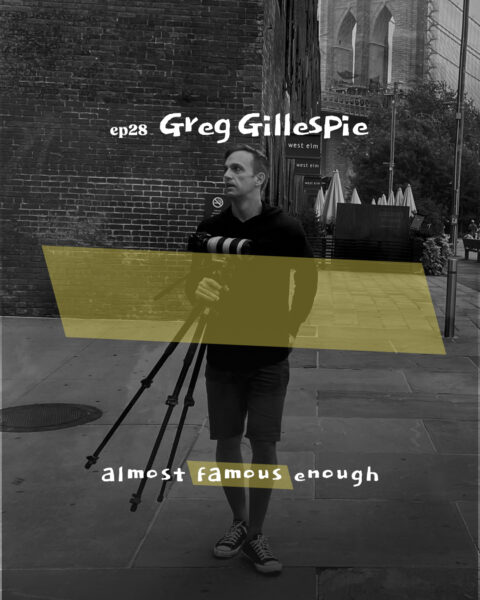
ep28 Greg Gillespie is my bestie
released Nov 13, 2025
1:40:26
Greg Gillespie Instagram: https://www.instagram.com/greg_gillespie/
In this heartfelt and wide-ranging conversation, Glen Erickson sits down with longtime friend and collaborator Greg Gillespie—videographer, musician, and creative force in the Canadian music scene. The episode explores the unique bond between Glen and Greg, tracing their shared history from church music circles in Edmonton to creative adventures in Vancouver, Iceland, and beyond.
Together, they reflect on:
The episode is a candid, unscripted conversation between friends who have seen each other through decades of creative pursuits, personal growth, and the ever-changing landscape of music and art. Whether you’re a musician, a fan, or someone who loves a good story about friendship and following your passion, this episode offers insight, humor, and inspiration.
Mentioned in this episode:
Connect with us:
hosts: Glen Erickson, Alexi Erickson
Almost Famous Enough website: https://www.almostfamousenough.com
AFE instagram: https://www.instagram.com/almostfamousenough
Almost Famous Enough Spotify playlist: https://open.spotify.com/playlist/1o1PRD2X0i3Otmpn8vi2zP?si=1ece497360564480
Almost Famous Enough is a series of conversations centered around the music industry, pulling back the veil on what it really means to “make it”. Our podcast features guests who know the grind, who have lived the dream, or at the very least, chased the dream. Through these conversational biographies, truth and vulnerability provide more than a topical roadmap or compile some career advice; they can appeal to the dreamer in us all, with stories that can teach us, inspire us, and even reconcile us, and make us feel like we made a new friend along the way.
Chapters
00:00 Introduction
02:39 Catching Up with Greg
03:37 Revisiting Old Memories
07:08 Musical Journeys and Church Influence
12:32 Creating and Collaborating in Music
38:47 Transition to Video Production
42:22 Balancing Passion and Practicality
45:59 The Importance of Community in Music
49:35 Dealing with FOMO and Creative Desires
54:04 Reflecting on the Music Industry
55:00 Balancing Passion and Practicality
55:50 The Importance of Music Communities
56:20 Personal Integrity in Music
56:48 The Role of New Sounds
57:11 The Impact of Familiarity
57:33 Sharing Music and Experiences
58:44 The Iceland Documentary Project
01:02:18 Ambassadors of Culture
01:03:10 The Struggle of Creatives
01:08:39 Spirituality and Music
01:25:37 Post-Fame with Alexi
ep28 – Greg Gillespie is my bestie
[00:00:00] I am not sure where to start writing an episode intro for one of my best friends. There’s no bio to review, no discography to highlight, no standards I can fall back on because it isn’t that kind of conversation. Maybe I’m running a risk stepping outside the content algorithm I’ve created to guide my typical guest, but maybe I know the story I tell about myself.
The story I am acutely aware is being woven through each conversation and each episode as I swap experiences and perspectives with guests. That story is particular to my purpose here, and no one knows the story. Like a best friend Greg Gillespie is a videographer. I think I’ll, I’ll go with that. He has made a living behind a camera.
Behind an editing screen and had the fortune of making the people and players of the Canadian music industry a common client, music videos, long form, short form [00:01:00] documentary. His skills have taken him to a bunch of places in the world to meet a lot of different kinds of people. I think you’d be surprised how often the person behind the lens is learning the most about what’s happening in front of it.
Greg has a way of taking it all in processing with empathy, vision, especially curiosity. We’ve been talking about what inspires us, what we love, what we feel for decades now. I can’t speak for Greg, but I’ve never left those conversations without a better sense of myself, of being seen before. It was a thing to be seen.
What if we could talk about our personal experience of chasing the dream together, the way we talk about everything else, what would that excavate? What would be of value for the rest of you? I don’t have an answer for the rest of you, but for me, I heard someone I respect and care about. Remind me about some lessons.
We’ve learned, some [00:02:00] truth about our world, and how to look at the big picture again and be okay with it. Maybe this episode was in danger of being just for me. Maybe I’ll have to be okay with that. Or maybe we can all put down our pursuits for greater meaning and just hang out with our besties and feel grounded.
Again, my name is Glen Erickson. This is Almost Famous Enough. Thank you for spending your time with us. This is Greg Gillespie.
Glen: Well, the nice part for me is this always lets me catch up with people in a different way, at the very least. But,
Greg Gillespie: Yeah,
Glen: anyhow, so I hit record Greg Gillespie very, good friend. I even call you my bestie, essentially everywhere. Um, I feel a little bad that this isn’t a you, me, and Joel conversation.
Um, [00:03:00] I think anybody who knows us kind of knows that, least in the last half of our adult life relationship, it feels like it’s kind of been a constant circle of when there’s a chance to get together. It’s often the three of us trying to get together. So, uh, I might have repercussions later not bringing Joel into the, into the call.
But, anyhow, thanks for being here. You’re, you have, uh, you have the house to yourself, or you have the somehow
Greg Gillespie: the moment, someone’s gonna be crashing in, uh, in the next half an hour. I think. So
Glen: Okay.
Greg Gillespie: this, this, this is why I’m like in this room right now. So here we go.
Glen: Yeah, I get it. I
Greg Gillespie: yeah, yeah,
Glen: So you are, this is, this is fun for me to know is like, you guys, you’ve lived in the same place in Vancouver. how many years is that
Greg Gillespie: yeah. This is
Glen: that
Greg Gillespie: 18 year. 18. So we moved when Berlin was born, basically.
Glen: Okay.
Greg Gillespie: And now we’ve, we’ve made it all the way she’s gonna leave this year. Harry Potter laughed the [00:04:00] stairs all this time.
Glen: so that cramped, you know, typical Vancouver downtown situation will finally maybe have some relief again. Um, that you, not that you want it. I know you don’t want it. I know you. And none of us want our kids to take off right away so soon and, and stuff, but she’s got, she’s got some school considerations around the corner.
Right. So
Greg Gillespie: Yep. Yep. She’s gonna be going to, uh, the right state in the wrong country, so, uh, Eugene, Oregon. Yeah. So it’s all right.
Glen: I totally get that. I totally get that.
Greg Gillespie: Um.
Glen: Like I told you, like, I wanted to have some different conversations. I was trying to, uh, full transparency, spread them out in my season, about some different conversations than just the typical one-on-one to an artist conversation that I’ve been having so far on the podcast.
So I wanted to look at some different options and they, and it looks [00:05:00] like just the way the luck of scheduling and things have rolled for me that, I’ve run, like I had a conversation with my old band, which was kind of a unique conversation, and I had a conversation with, uh, my friend Ryan Langlois, and then son just starting out in music when he’s kind of, late stages kind of artist.
Um, and I wanted to talk to them together and I thought that was kind of a different angle I wanted to approach. And then I thought,
you know, the approach of
Greg Gillespie: approach of having
Glen: the you and I, you and I, is that, well of all the people
Greg Gillespie: all the people in the.
Glen: you know, you’re down to like. You know, first, second, or third piggy on any given day of who I want to talk to at any given time.
And, and that, um, the kind of conversations we usually have, either over drinks in Edmonton at The Next Act or in Vancouver at The Morrissey, because that’s pretty much where we’ve locked into for the last decade, which is awesome, uh, is a kind of conversation I, I would love to have again. And I, I guess I [00:06:00] just wondered what sort of pieces of that might be of interest to other people and, to be completely frank, because a, uh, I’ve been talking, you know, with little tidbits of my own life and career through this entire podcast, and you’re one of the only people who’s seen all of it from start to finish and kind of been not very close to the inside of it at a lot of different times.
And, So there’s a lot of value in that and just, I think both of us just share, you know, a passion for the creative things inside of us and getting them out and participating in all of those
Greg Gillespie: All of those.
Glen: they’ve come and gone in different ways in our lifespans so far. And I think that’s kind of of interest, um, you know, thematically for me about chasing the dream and what that looks like.
And sometimes that’s talking to people who’ve had a full career in it. And then there’s people like you and I who have, you know, [00:07:00] touched different parts of it all around. So, um, if you’re game, I thought we could do that.
Greg Gillespie: Let’s do it.
Glen: Okay. Okay. Well let’s go all the way back, like, uh, you and I met, what would we say that was?
I came to Edmonton in. 1996, so it must have been pretty quick after that.
Greg Gillespie: Yeah. I left in 97, so I think it was a revolving door kind of thing. And I feel like one of our first conversations, or long, deeper conversations was that like, oh, if we lived in the same spot, we’d be good friends. I’m sure, because I would come back to Edmonton and, and our, our circles would sort of overlap a little bit.
Glen: yeah,
Greg Gillespie: but, so in a way we sort of had parallel, um, lives, I guess, you know, with, with some of the same friends, some of the same music friends, and.
Glen: I guess what always baffles me is I can’t remember how long that window then, if I came in 96 and you left in [00:08:00] 97, I’ve tried to sometimes think, how long is the window when we were crossing paths regularly, and like you said, with the same circle of people, and just immediately, right, like I came from a place. You know, our backgrounds first and foremost, were like, we grew up church kids and church, church life. well, certain sectors of church life for people have great opportunities your craft as a musician because, know, they’re, they’re always looking for somebody to volunteer. And it’s all about volunteerism.
And if people can play and if they can play well, then you kind of have a spot in a band every week and you’re rehearsing and you’re getting your chops up and you’re learning how to be in front of people and, and learning how to improvise and all these great talents
Greg Gillespie: Talents can get
Glen: with, if you grow up inside a church circle.
So I had come, you know, to Edmonton and in my circles kind of always been known as kind of the guy, you know, like a go-to guy for like the cool [00:09:00] worship bands stuff. And so, you know, you and Joel were the immediate. Sort of, you know, same age frame, show up
Greg Gillespie: show up as
Glen: these are the guys who are known as the guy
Greg Gillespie: the guy.
Glen: too.
So I had that
Greg Gillespie: So I had that deep draw
Glen: to you guys, uh, right off the bat and, and music and, again,
Greg Gillespie: again, like I struggle sometimes to go back.
Glen: the conversations that, made me feel like, were we just
Greg Gillespie: We just talking about
Glen: You know what I mean? Like, who was like. Who we were into at the time.
I don’t even, I don’t even know. What I
Greg Gillespie: what I know.
Glen: you, seemed way cooler than me. And I’ve, I’ve, in my, uh, in my reflectiveness of my life, I’ve realized, I’m one of those guys. That’s kind of the textbook. I try to like go make friends with everybody who I think has a little bit of higher status than me, you know, to pull myself up.
So, yeah, you definitely seemed a little more cooler, and especially in church culture. Like if there’s somebody who came, you know what I mean? [00:10:00] The guy who came to church and didn’t look like maybe he belonged in church be like, that’s the coolest guy in church for, sure. But, uh, what I love about you too, bud, is you haven’t changed.
Like, you’re still wearing the black t-shirts and the band shirts and the, and the, all that stuff. So, anyhow, that was some of my. First re recollections and like, I think you’re right, like you moved right away. But then, you know, I don’t know, by what miracle we just kept staying in touch and whenever I’d come out to Vancouver, I’d look you up. We’d kinda
Greg Gillespie: Yeah. Yeah.
Glen: who was,
Greg Gillespie: I feel like we got closer afterward. You know, like with those more intentional, like if you’re in town and you have someone to look up, or if I go back to Edmonton, I’m kind of picking and choosing. I don’t have a lot of time, so I like, I want to be friends with this guy. You know? I feel like, uh, I, I don’t know if you feel this way, but there’s almost like, um, understanding the similarities of where we come from and our experiences.
There’s a real depth in [00:11:00] understanding ourselves. Not that I’m just hanging out with people to try to figure out my, my problems, but you know, it’s just, uh, there’s an overlap that, an understanding that we have. And with Joel too, like just that weird. That church background is a big part of it. I think there’s a lot, you don’t have to explain.
There’s so much explaining you have to do now, like with that background, right.
Glen: yeah, having somebody that you don’t have to cover all those bases and get caught up on every time. Right. Like we, you know,
Greg Gillespie: You know,
Glen: we could skip over like a large amount of stuff and just arrive at the same place. And I think, you know, when, you know when people talk about, oh, like that’s one of my best buddies.
’cause like we don’t see each other as much, but every time we do, we just can pick up from anywhere. And I think that’s sometimes without knowing it, that’s what people are describing is that large portion. If you have shared history or shared experiences, that you don’t even have to. You know, it’s not like we were digging in and excavating, although we did our [00:12:00] fair share of that over the years to those shared experiences.
But yeah, not having to do that. I, I felt
Greg Gillespie: I, I felt like for me
Glen: this aspect that you had this artistic drive, right? That like, was really attractive to me. That that, you know, the way that you were approaching the guitar, way that you were approaching
Greg Gillespie: to music,
Glen: interpreting your influences, both just when we talked, but just musically at that time was not the way I had been
Greg Gillespie: I have been coaching it,
Glen: you know, that’s, that’s
Greg Gillespie: so that’s always super
Glen: Like, I think about how any of us continue to be better musicians. And I
Greg Gillespie: short.
Glen: ever thought about this, you know, when bands are like three, four, or five records deep, like bands that have a good career and I’ve heard them answer. Like talk shows where they’re like, you know, what are you listening to these days?
And they don’t even have an answer. Like they, they’re so driven into just creating their own that, and that always
Greg Gillespie: That always seems so
Glen: This idea that I’m not having somebody else kind of inspire me or [00:13:00] influence me to look at it a different way. ’cause I think back to even our early days of relationship, and that was you, you know, like if we sat around and
Greg Gillespie: sad around, picked
Glen: you’d do a cover of something.
You were, you were the classic guy who could
Greg Gillespie: the guy
Glen: and you would start playing an inverted chord structure underneath, underneath a popular song or some,
Greg Gillespie: on.
Glen: arrangement that I was like, I never thought of that. That sucks. Why did I not think of that? That sounds so good. But yeah, those are some of my early musical collaboration days, talking about all of that. so.
In our
Greg Gillespie: in our timeline,
Glen: yeah, let me
Greg Gillespie: actually, let me do this, let.
Glen: frame our time around, like, since that’s what we’re talking about, right? A little bit right now, um, for people listening is that, yeah, you moved to Vancouver in 1997. I think that
Greg Gillespie: I think that was a
Glen: a lot. Like, I liked to get away and go out to the west coast a lot and I think we did doing a little more hanging out, you and, and your wife Alexia who, full transparency [00:14:00] is the namesake for my daughter Alexi, who I co-host this with, came from your wonderful partner.
and
Greg Gillespie: and
Glen: out to visit. And you’re right, I think we got closer, by being apart and being intentional. and then at
Greg Gillespie: and then at some point I heard
Glen: when after I wasn’t involved in the church anymore and I started doing music on my own then. There’s a couple things that
Greg Gillespie: things that happened there.
Glen: started the record label in about 2002. ‘ and
you released, uh, an album on that label And it was one of the first things I ever put out, which was Trainsleeper, which is the project called Trainsleeper.
And I was playing mostly with an Edmonton band called f and m at the time. I’m wondering what
Greg Gillespie: so I’m wonder.
Glen: is of that time were when you were like making music. Were you living in Victoria at that time when you were making that music
Greg Gillespie: Uh, no, that was, that was after Victoria. Yeah. Yeah. So, so yeah, we were living in Victoria at that point in Victoria. I was a [00:15:00] lot of, I was playing at another band with, uh, Scott Carps. It was called, it was called Crowthorne Gypsy Barn Gothica. So
Glen: Oh,
Greg Gillespie: just a
Glen: What’s that
Greg Gillespie: you gypsy barn gothica we called it. So yeah, memorable gig was opening for a shock rock, group called, I think she was called Cherry.
Yeah. A lot of things happened on that stage, but our band was a little, just more like, I dunno, like kind of Zeppelin esque or whatever. It wasn’t my, uh, preferred genre, but I got to play bass and it was just fun to play and I played a lot of church. Music at the time too, I was writing a lot because I didn’t like church music.
And so I think that’s something we had in common too, just like trying to make something, uh, true to ourselves artistically. So then, um, yeah, I think honestly I think there your influence, Uh, there was your influence on writing that record. [00:16:00] in, uh, when I, uh, moved to Vancouver at some point you said this, this could be 75% true, but something to the effect of there are, there are talkers and there are doers, and you were gonna be a doer.
And this was, I think this was you referring to making the label, you know?
Glen: Yeah.
Greg Gillespie: so I think that inspired me. It’s like, am I, there’s always been this question like, am I actually a musician? You know, because there’s that church standard. It’s like, oh, you own a guitar, guess what? You can, you can play. And there’s like so many degrees of, um, you know, of quality and ability, which I love about it too.
It’s very accessible. But, um, but I kind of felt like, okay, I, I think I can write songs and so if Glen can make this label, maybe I can actually. Write an album and I’m not really sure who, and at that point it was for me, I guess like that was the [00:17:00] interesting thing with writing church music is you always have an sort of audience, I guess,
Glen: Yeah.
Greg Gillespie: that low barrier.
So this was like, okay, if I write something, this could just be the for myself, you know?
Glen: Yep.
Greg Gillespie: and so it was it, it was very affirming to have you pick it up thinking that someone else might enjoy this as well.
Glen: Yeah, well, I mean, I was
Greg Gillespie: I was convinced.
Glen: would enjoy it as well. ’cause I thought it was fantastic. Um, I don’t
Greg Gillespie: I don’t like, I remember,
Glen: I remember knowing that you
Greg Gillespie: remember knowing.
Glen: and maybe you had either, maybe it was just you playing me some in person or whether, I don’t know whether you had actually demoed anything and sent me, I can’t remember which it was, but I knew that anything that you were gonna write and record, I was gonna on if you wanted to. so I remember probably pushing you, but I remember probably like strongly hinting that [00:18:00] like, we should do this thing together. For sure. I did you
Greg Gillespie: Did you record?
Glen: Anderson? Like,
Greg Gillespie: I recorded everything in our apartment, very similar to this one, just older. And then I went to Jonathan for mixing,
Glen: Okay.
Greg Gillespie: uh, mixing and drum sound. So honestly, I rented this some task scam recorder from, uh, long McQuaid. It had like, you could burn a CD in this like eight channel recording thing, like you hit a little master button and spit it out.
So I took that to Jonathan Anderson, John Inc.
Glen: Yeah.
Greg Gillespie: To his studio and like, Hey, let’s, you know, like dust it off. So I’m trying to think if at his studio there was no performing, it was just, uh, mixing and drum sounds together. Yeah.
Glen: was he able to separate the tracks? Did it burn them all down flat, or
Greg Gillespie: Oh, so I could, yeah, I could do, I could do both. [00:19:00] Yeah. So,
Glen: Yeah,
Greg Gillespie: so we had tracks.
Glen: what a, what a pain
Greg Gillespie: Yeah.
Glen: yeah, which is cool. ’cause that was my introduction to Jonathan Anderson, um, Jonathan Inc. Who has made some incredible records that still love the sound of to this day and has done gone on to make, you know, even a greater career producing, just such a skill for producing, especially lush, layered textured sounds and, and artists, uh, you know, on the West Coast, he’s done such a good job for.
So that’s kind of cool that I’ve now been able to have, you know, kind of a distant relationship with that guy. That was through your introduction back then. okay. So what
Greg Gillespie: Okay, so what I remember about that,
Glen: The most fun part of that era was you, because, because I don’t, everybody,
Greg Gillespie: everybody, like
Glen: probably a good half of my demographic will know this and maybe half don’t.
So, but the two thousands especially kind of was, you make a [00:20:00] indie record and then your CD release show was like everything, like you put. You basically put 99% of your effort into making a record and a CD release show, and you had like nothing left over to actually work on your career. But everything went into that and a release show.
So we had to do some version of a cool release show, I remember. Right. And you had connections out in Vancouver as and Victoria. So you booked a show in Vancouver, can’t remember the name of the little place or
Greg Gillespie: Yeah.
Glen: who was really cool, who ran it and booked the places. And then you booked a place in, in Victoria that you knew.
And, and I arranged for coming out with Fosters and McGarvey as we called ourselves back then. But it was f and m to basically share those shows with you. ’cause I think they had just released something right around the same time. and these were all the first few handful of records even on the label.
But uh, do you remember what that venue was
Greg Gillespie: Yeah.
Glen: Vancouver or where it
Greg Gillespie: Yeah. [00:21:00] Yeah. Vancouver. In Vancouver, it’s the Sugar refinery. There’s actually a place called the Refinery there. It’s on Granville Street. So that’s like the bar strip, right. But there’s this, it was this cool like, kind of art school grimy little venue that would sell like Pierogis and they, the, I think the fire department would shut them down all the time.
Actually, Ida, oh, I forget her last name. Her, her, her artist name was gr great, great Aunt Ida.
Glen: Grant.
Greg Gillespie: was in a band, a band called the C Word, uh, at the time. So I was always tickled. ’cause in the ge, uh, like you want to see your name in the Georgia Strait? And they, her band was playing the night before, and I’m like, oh, sweet.
Like train sleepers under her band name.
Glen: yeah.
Greg Gillespie: can’t clip this out. Yeah. So it was,
Glen: did share a stage with great Aunt Ida later on in Edmonton. They came through
Greg Gillespie: oh, cool.
Glen: She
Greg Gillespie: Yeah.
Glen: me at all, but. It was a cool little, it made me think of a Toronto bar. You know how they’re like [00:22:00] long and narrow. That’s how I remember it, is like it going kind of long and narrow to the back type thing. maybe that was the Victoria one. Maybe I’m colluding the two. yeah, I don’t know what you
Greg Gillespie: I.
Glen: about those two shows. think it was Victoria the second night, right? We went across on the ferry and what I re all I really remember the most is that, Ryan, the lead singer for f and m got, uh, it drank way too much and started berating the audience horribly for, not giving enough of a shit about the music being played or, and something.
And I was so embarrassed because I. was kind of like you had built like a real good community in Victoria, and so they’re all there to support you. Right. I think maybe you guys played first because it’s that old sympathetic, like, this is your crowd. I’m gonna let you play first so that they don’t ’cause so they can go home [00:23:00] or they, you know what I mean?
Like some of them wanna stay up like super late bar hours and we’re gonna concede to like your friends. And, so we went on after and then a bunch of people maybe left or a bunch of people are talking as they should, right? They’re excited about what they just heard and talking with you and everyone else.
And, Ryan made a bit of a messy performance performance, which, which to his credit, like it wasn’t long after that that he kind of cleaned that up, right? Because he was serious about making music. They still make music. So, uh, to his credit, he cleaned up. That act pretty, pretty quick, but it was pretty, it was pretty unhinged that night as I recall.
Greg Gillespie: I don’t remember that actually. So maybe I was the one talking and we just kept our conversation going. I don’t know.
Glen: you and you, you guys had us stay at like a little, like, for lack of a better term, a commune. It was like a, like we, we stayed, I don’t know what it was, whether it was a set of apartments or this house that had a bunch of rooms and, [00:24:00] you know, it was like a
Greg Gillespie: It was like a,
Glen: and then everybody kind of had their own place or
Greg Gillespie: yeah,
Glen: these kind of And um, yeah, it was a different experience for sure. But
Greg Gillespie: yeah, yeah. There was a real music community in Victoria, like, so I’m trying to think like, was that our old, because we lived in a house with, when we lived in Victoria, so this is before that time, but that house was let going, but basically it was like. Six, you know, a character house, everyone gets more by pooling their resources.
Right? So then we’d have these music parties and the whole thing with the music parties were no spectators. You have to bring something, a poem or a song, but like we just didn’t want it to be a party or the same old people pick up the acoustic guitar or whatever. Right. and I felt like it was high support, but also high challenge.
Like people rose to the occasion. People who I expected to like give polite. You know, uh, [00:25:00] applause to like blew everyone’s minds with their, their lyrics or their talent. And so I feel like that still exists. There’s somebody, so I dunno if you remember Scott Carps and Trinka Carps.
Glen: Yeah,
Greg Gillespie: they,
Glen: remember.
Greg Gillespie: so he played, uh, oh, he played with Trainsleeper that night.
He played, uh, mandolin, electric mandolin, and he, um, so he has a house music venue and they built a stage in their backyard. So. Uh, like for, and, and it’s really up to their taste. So if artists wanna play, actually a number of artists do wanna play, but they just kind of pick and choose because they can’t really, he doesn’t wanna do that full time.
He just, he is doing it as, um, a means to an end. He just loves music that much. Right. So like kind of true patrons of music, which I think are like people I really look up to, especially now. Like he is not a musician by trade, but I would say like, he’s like one [00:26:00] of the most important musical patrons that I know.
Glen: yeah. cool. I
Greg Gillespie: Yeah. I.
Glen: if you can connect to those in your community, that’s pretty. Cool. And I think what’s interesting is every community has those guys for sure. And they aren’t the ones that are grabbing the headlines, know, of, of whatever is producing the headlines at different eras that we’ve gone through.
But they always exist for sure. mean, I mean similarly, there’s, there’s a guy I know
Greg Gillespie: Guy.
Glen: who’s run what’s called a song circle he is run it maybe for a decade, maybe more, I don’t know. But he even found a way through COVID kind of when the opening and shutting, you know, he persisted in finding a way to still have, know, people that would come together for the same thing.
As you said, there’s no, no bystanders. It’s everyone’s a performer that shows up and, and, um, anyhow, I just think that stuff’s pretty cool and pretty [00:27:00] important. I mean, it’s
Greg Gillespie: I mean, it’s interesting because,
Glen: You were writing songs, you know, and thinking about how I was kind of going through this, like, I need to, I need to be a, a doer, not a talker in my life with this music stuff right now.
Um, and I, I, you know, I
Greg Gillespie: you know, I think
Glen: lot of
Greg Gillespie: a lot of people.
Glen: a lot of people
Greg Gillespie: Lot of people are.
Glen: right? And, and I love that
Greg Gillespie: I love that you just said it, like
Glen: and you were aware that you had, if you were doing it, you were doing it for
Greg Gillespie: doing it,
Glen: for sure. And anything else was possible, and maybe you were being shown some possibilities, but it really wasn’t clear ear. So you really
Greg Gillespie: so you really have to.
Glen: whether you wanna put everything that it takes to do this thing just for you. Right? I don’t know. I think a lot of that’s where a lot of people stall out. From this thing, right? I don’t know if you’ve met a number of people in your time that have like had this great potential. [00:28:00] know what I mean? And then they seem to out if they can’t sort of see a roadmap drawn for them right off the bat. I don’t know. Does that make sense?
Greg Gillespie: Yeah. Yeah. I find that, uh, really depressing, like where people, I feel like people maybe have a narrow view of what being involved in music is. And maybe that view for a lot of people is like, oh, I’m gonna be able to do this full-time, or at least part-time and, and have this many people listening to my music.
And, and if it’s not, and actually like, if it’s not economically viable, I can’t do it. And I can’t fault anyone for thinking that way. Like, we have to pay our bills and everything. But, but how many people sort of give up even on playing at all or being interested in music because the, because it’s can’t be their, their job.
And then, uh, I don’t know. Like I, and I feel like it [00:29:00] was never really for me, I’m. I’m sad that it was never, I, I don’t think I was ever good enough or, or ambitious enough to have it be a full-time thing. I don’t know if I was really serious about that, but, um, but I’m happy now.
Glen: for you maybe than you were like. I was
Greg Gillespie: Yeah.
Glen: for you your behalf,
Greg Gillespie: Oh yeah. Thanks. Yeah. And I don’t know, and it’s hard to people, I think about maybe our parents’ iteration, maybe couch those questions a little bit of like, oh, are you still doing that music thing? Like, have you got over that yet?
Glen: Yeah.
Greg Gillespie: and to me that’s just So,
Glen: it’s a
Greg Gillespie: just la Yeah. And, and more and more I find, um, as I get older, I see the importance.
I mean, we don’t have to go down this tangent now, but I’m sure we will next time at Next Act is like, you know, we’re AI. A, like, AI is [00:30:00] sort of changing how we’re looking at music and music creation altogether. And I’m seeing as that, as I’m getting older and more curmudgeonly, I think like it’s more and more important.
Music’s going to save us, you know? And so, so finding a way to be involved with music, whether or not that’s even me picking up a guitar, like I, I feel like it’s more important than ever for me to like buy a, buy a ticket and go see a band with like 10 of their friends, you know, because they’re like taking the torch, right?
And just sort of, and appreciating it. Uh, like widening my view of what being involved is, is I find becoming enriching. It was hard to get to this point. ’cause there’s a lot of disappointment along the way. Your dream’s dying, you know? Or like, I’m, I’m not playing anymore. Like, am I just out of this altogether?
But I think it’s important, I think it’s important for people to see that as, um. An option and actually, and something they should, they should do. Everyone should be [00:31:00] involved in music. We shouldn’t give up on it.
Glen: See this is why you and I get along so well. ’cause you just like summarized my entire life and podcast concept in like the last 38 seconds, I think. Um, which is absolutely amazing. Like, so first of all, like the point about the AI music you write, that’s a big rabbit hole. you were just making the point about why the way we’ve made music till now and the place it’s held is so important in the face of the changing aspect of creativity and what, and how something gets created maybe is more important to say, right. like, how important is the human element of something that’s created. Right. Versus just ideated because we’re, you know, we’re creating it from prompts, so we’re just giving something, a concept or a strict, know, set of parameters or criteria and [00:32:00] it’s creating something, air quotes for us. Um, versus like,
Greg Gillespie: like
Glen: you know what happens
Greg Gillespie: happened?
Glen: who makes something also performs something and it makes you feel something and I get feel is very subjective and it’s not impossible to feel something from AI generated. but like you said about going out to see people live and just making a choice to participate in this like human experience, right? That someone’s playing music, but then people are receiving the music and both are required for that human experience, right? Or someone’s pressing it to vinyl because so many people need to put the headphones on and experience it, you know what I mean?
In a way that feels even better than just, you know, other delivery methods or whatever. So
Greg Gillespie: So
Glen: [00:33:00] like, that’s
Greg Gillespie: like, that’s so important.
Glen: like
Greg Gillespie: I, I’ve been like struck,
Glen: ’cause I don’t, I have a lot more trouble getting inspired these days and I don’t know if it’s the curmudgeon bit, um, or that I just keep my eyes open to a lot and maybe I’m oversaturated, right?
Um, it could be a number of things, but, uh. I’ve been inspired
Greg Gillespie: fired by
Glen: tiktoks of a guy who I
Greg Gillespie: water.
Glen: even listen to. Maybe you’ve heard of Yungblud, from the UK and, and you know, total rock and roll, like black eyeliner, no shirt, leather pants, like throwback to Steve and Tyler or or any of these guys.
And so he actually is up, I just saw this yesterday. up for
Greg Gillespie: For
Glen: Performance of the Year when he did, uh, the song at the Ozzy tribute and it was such a powerful [00:34:00] performance, right? And so palpable and I don’t even have to love that stuff. be just captured by it and the feeling and watching a crowd get totally lost in it, right?
And, and people who had a love of music and a man who stood for a very specific kind of music that had a huge appeal for decades together to mourn and somebody owning that moment that way. Like it’s just so rare. Like I just, those are the
Greg Gillespie: Those are the moments of,
Glen: at is like, I don’t know how AI generates that for us at some point. And, you know, not saying it, you know, if the movies are correct, it won’t be able to at some point. Um, but yeah,
Greg Gillespie: yeah.
Glen: is like something I, I’m at the point of right now. I’ve been talking and maybe I’ve talked a bit about it on the podcast, but I talk about with Lexi a lot of, I’ve been trying to go
Greg Gillespie: Try to,
Glen: more. ’cause I want to [00:35:00] get plugged back into that feeling of community of like, I don’t have to know the people around me, but we’re sharing the same experience and this, know, we’re receiving this the same way somehow despite how different we all are. And, um, it feels so important to me at this of life.
But, but you were
Greg Gillespie: but you were also saying earlier, Greg, um,
Glen: yeah,
Greg Gillespie: yeah.
Glen: of like, you know, at some point you decide whether or not you’re gonna be ambitious or good enough and you know, which side of those tips to scales as to why you, maybe people don’t continue on trying to be the music makers. But you basically, what you were saying made
Greg Gillespie: Saying
Glen: like what the point of this conversation is to me and the point of why I feel like I have a special bond with you. you understand it in me like nobody [00:36:00] else does really. Which is like, I have to be a part of this creative world And the pursuit of it, I mean, it’s showcased
Greg Gillespie: showcase.
Glen: chasing the dream of the rock and roll dream, right? Like it’s all or nothing. Like you said, like some people might be like, if I don’t, if I’m not gonna be a rock star, if it’s not gonna pay the bills, then I, then I stop early and it’s never gonna pay the bills.
Like, it’s not financially, uh, reasonable to pursue music. Uh, even less so right now. ’cause, you know, um, but the pursuit of creativity and the pursuit of all the ways that you can still have that such a big part of your life. Is where you and I kept intersecting, right? So besides just our personal life and again, like getting drinks, diving into what we’re listening to, how it’s making us feel. I even told someone the other [00:37:00] day, like, you and I started burning CDs for each other way back. You know, you start, you started it with your songs for winter, the first CD you ever made me. ’cause you and I both go into right now, we’re like right now in the heart of stepping into melancholy season, right?
Which is
Greg Gillespie: Yeah.
Glen: our sweet spot for
Greg Gillespie: Yeah.
Glen: like you and I. And, uh, the burning CDs gave way to thankfully in, in a lot of ways Spotify playlists make it easier to, you know, the old curmudgeons don’t wanna have to try and go and burn a cd. I don’t know how I would anymore. None of our computers have the burner on ’em, but. Um, but we’ve been sharing like our music playlists and especially our melancholy season ones forever. Um, but then,
Greg Gillespie: then, then we kind of.
Glen: which I find interesting again, when we talk about, you and I weren’t directly necessarily making music, well I was at the moment, [00:38:00] but you got into video and video production and stuff like that and kind of found your way to being around music a lot. You ended up making videos for my band, the We Pool, and a number of my friends out here in Edmonton, and then you got plugged into the community in Vancouver. So I’m wondering how, I’m wondering how that happened for you. How did the journey happen that you’re like, this is a skill I can do just in one?
And then also did it just feel like. Was it just hanging out there for you to get connected to the music, or was there some like serendipitous connection you made that you got to kind of join those things together? How did that happen for you?
Greg Gillespie: Yeah. Uh, well, I went into video from teaching, so that’s what I, that was my real job training, getting a teaching degree. And I [00:39:00] remember having, uh, a moment in the staff room where some, uh, colleague made a grammar joke that was, uh, not really that funny, but I got it. And everyone laughed. And at that, that moment just the camera pulled away and I saw myself in the staff room with all the lifers, and I’m like, I cannot be a lifer here.
Like, there was something, and I think the creative process, I think it’s related to our, our church past too. Like, I think in the environment that we grew up, or at least for me, there was this sort of feeling of like. Doing what you’re supposed to do, what you’re, uh, quote called to do. So like within you, there’s some kind of like meaning of life or you have like a, a gift you need to share.
I,
Glen: everything
Greg Gillespie: like it,
Glen: Everything has
Greg Gillespie: has, yeah. Yeah. So then if you’re like telling grammar jokes in the staff room, knowing that there’s [00:40:00] something, there’s a creative itch that’s not being fulfilled, that was kind of like me looking at the exit door. And then, and I also was really drawn to photography anyway, so for some reason there were a few music videos that really were powerful to me.
Um, and I, I, I loved film as well, and so I thought that would be kind of a vicarious way for me to be in the music world. Through video, right? So like, like a Wes Anderson sequence with like the, just the, the perfect song Mordecai being released from the, the top of the Royal Tenenbaum mansion or something.
Or like a Sea Rose video. Like to me that’s just like, all the senses just exploding, right? And so I felt like that was a way for me to kinda enjoy all of that. I could be around music maybe, and I felt like with my own music, I dunno if you remember those, um, CD released parties. [00:41:00] It was all about the, like, the projections behind, like, I wanted, like all of that stuff, you know, like, so a multisensory experience.
So I guess that’s sort of. Was my, my thinking of going into video with the intention of being around music people. And I do have to say, I would much prefer being around music people than film people. I don’t know. And so I, and there’s not really a grief for me, like if, like, uh, if I go into the studio and somebody, like, we’re recording, uh, I’m filming a drum track or something, I just love it.
I just, I’m, I am enamored by the talent, like a, a little bit jealous, like, oh, that would be so awesome to be you playing. But mostly I’m just, I feel it’s a total privilege for me just to be around. And bearing witness to this talent, to people that, that stuck with it too. You know, and, and I’m looking behind the curtain, like I don’t really [00:42:00] have, um, like I don’t see them as necessarily super, like special in terms of stardom.
It’s more just like a deep respect for their, uh, perseverance.
Glen: Yeah. Yeah. I mean
Greg Gillespie: I mean,
Glen: a
Greg Gillespie: that’s a pleasant.
Glen: walk in and have a recurring fomo, know, by being around that. Like I know that’s something I’ve had to wrestle and exercise with myself for a lot of years and been a little jealous of the lightness that you have about it and bring to it.
Um, but I think that’s obviously what’s been really valuable in you being able to be successful and do a really good job with that and, you know, be around a lot of stuff. ’cause you’ve done, done everything right from kind of the documentary you’ve done the follow some people around, you’ve shot the classic, you know, video with the slowmo sequences and the, and the, was [00:43:00] always asking you for running sequences.
Do you remember that? I always wanted to have a running sequence in every like, storyline that I storyboard I made up.
Greg Gillespie: So good.
Glen: I just, I don’t know. And I don’t even watch Tom Cruise videos, but then later I realized like, Tom Cruise has a running sequence in every, what am I doing? yeah, I think it’s awesome to approach that without that level of FOMO all the time. to be able to still hang around. cause there’s a, there’s this weird, um, I’m trying to think of what the right word is, but you know, like I encounter people in different aspects, right? There’s the sound guy who ends up with this cliche, and I, I hated watching it. Sometimes like, young bands would treat sound guys bad, right?
It would be like a 50-year-old sound guy you know, was still wearing the Brock shirts from when he was 20 and they would get treated like, you’re the sound guy ’cause you never made it. Or some version like I’m oversimplifying, but that was essentially, and sometimes they [00:44:00] would get like not even treated really well.
Right. And, and I would see that in lots of different areas where, you know, there’s, there’s, I mean, a few of my friends around who are the best promoters around here in the city also played in they were younger in bands that had the biggest impact in our local community. And, and even were breaking out across the country and, and had careers.
And then it’s, it pans out for so few people, right? That a lot of people in the industry their way into the different industry level jobs because that’s what they sort of, in their nature were good at. And they learned it by when they were playing music and pursuing that. And then they end up doing that.
And sometimes it gets looked down on, I think it gets looked down on a lot like.
Well, you said you were a teacher or you got your teaching degree and that’s where you were headed. You know,
Greg Gillespie: Mm-hmm.
Glen: like those who don’t, I don’t, how does it go? Those who don’t do teach or, or
Greg Gillespie: Right. Yeah.[00:45:00]
Glen: that, that thing, and it sort of gets translated, I think in the music community sometimes.
Like all these people doing these other jobs are the ones who didn’t make it, which kind of sucks.
Greg Gillespie: Yeah, yeah. Totally. And on that, I think like our demographic too is like, trying to figure out how to be involved yet. Stay in our lane, if you know what I mean.
Glen: Yeah.
Greg Gillespie: it’s, it’s tricky, like, I guess like growing up, so you’d see that I was never like rude to the old timer at the sound desk, uh, to my recollection, but, but there’s that guy, like there’s that old dude in the black shirt at every show,
Glen: Yep.
Greg Gillespie: the hang the hanger on.
Maybe if some people would call it that way. And now it’s like, oh, I think I might be that guy now. You know what I mean? Depends on the, like, like some, I went to this, uh, show, like it more of a DIY sort of punk show, like last year. And I was [00:46:00] like, I think if I took any two people in this room at their ages, I’m still older, you know, but they, but to their credit, like the bands were super stoked that I, you know, I, I was the rando, right?
Like, oh, there’s a show I,
Glen: yep, yep.
Greg Gillespie: pay. I like, I feel like it’s my job now. Like how many times like. Our parents would buy a bunch of CDs to give to their friends, or, you know, like you’re just to now I have the means to support, so it’s the least I can do. Even if I leave early, it’s like, yeah, I’ll, I’ll buy a ticket, you know?
But, but, but at the same time, like, I don’t like how, like for a lot of people staying in your lane for the dad rocker is like, just waiting till Neil Young shows up or war on drugs or whatever and just go to those shows.
Glen: Yeah.
Greg Gillespie: know, like we still, like, maybe as a consumer people will look at it that way, but that’s not our interest in this.
Our interest is like truly being engaged with the music, [00:47:00] you know, on a deep level.
Glen: yeah. And I mean, well, again, like, I, I, I could say this, I’m gonna end up saying this 20 times through conversation is where you and I obviously relate so closely, is that I’ve always been the same way. Like, I want to go to the new punk show, or I want to know, you know what I mean? I, I’m going to the new shows, not the, old tours.
Um. More often than not, partially
Greg Gillespie: partial
Glen: and they cost a lot less than those big old tours. But, also ’cause yeah, I just,
Greg Gillespie: to that. I just,
Glen: vibe and that inspiration and you’re right. I feel like being a part of it is really important. yeah, I, I mean,
Greg Gillespie: I mean,
Glen: I don’t know if you
Greg Gillespie: I don’t know if you remember so.
Glen: know, you and I organized a group of like six dudes, seven dudes, I can’t remember to go.
Last October a year ago when the War on Drugs and The National came through Vancouver. I brought a few guys out from Edmonton and we kinda all got together and we’re gonna go to the show [00:48:00] because those two have been like, you know, my top pops me for the last decade most listened to probably. So them being
Greg Gillespie: So them being on the,
Glen: is like mind blowing.
So I was obviously super excited. Um. But I
Greg Gillespie: but I have this,
Glen: I have this
Greg Gillespie: I have this
Glen: uh, that, that it’s not dad rock, that it’s like literally the most legit cool indie rock still. And when we walked into Roger’s Arena and all I saw was who looked the same age as me or older, all I saw everywhere
Greg Gillespie: everywhere.
Glen: was just like, are all dads wearing their flannel from 98 and, you know what I mean?
Or whatever they pulled out
Greg Gillespie: Whatever they pulled out,
Glen: their last band shirt of the last show they went to.
Greg Gillespie: right?
Glen: generalizing a lot of them, but there was a lot of that there. But it was all overwhelmingly older dudes. [00:49:00] And I felt so uncomfortable and I had to ask, like, I had to think about it afterwards, like, why am I so uncomfortable with being, you know, that guy and that thing?
And the truth is like. You are right. I feel more comfortable, I feel more comfortable being as someone twice the age at a young indie rock show in a small venue. You know what I mean? Than, than being there for some reason. I don’t have a full answer for it yet. It’s probably because it won’t reflect terribly well on me, so I don’t want to think about it too much.
But yeah, that’s how I felt. And so I totally relate to that feeling.
Greg Gillespie: You mentioned earlier about the fomo, like when you’re, do you get that still or Yeah. Like all the time as bad or do you have ways to, to mitigate it or,
Glen: man. Like,
Greg Gillespie: yeah.
Glen: you know, if I could, like, there’s a handful of things in my life if I’m being really, really transparent. There’s a few things in my life that, you know, since we grew up in the church, I’ll use the religious [00:50:00] metaphor, when wants his like, uh, thorn in his whatever to be taken out by God and everybody tries to guess what awful sin was in the Apostle Paul’s life that was so bad that he would be freaking out and asking God to take it away, but God wouldn’t take it away and blah, blah, blah, who cares?
But, there’s a few
Greg Gillespie: Are the two things.
Glen: I’m like, I wish I could just take these out. Like, and, and it’s partially sometimes ’cause I think they don’t reflect well on me and it’s embarrassing. And other ones that I just, it’s just painful to go through. And one of them is the fact that I, I can’t get over that.
I, always wish it was me, you know, like I just always wish it was me and ‘ cause I, there’s nothing I love more, right? There’s just nothing The moments,
Greg Gillespie: Moments, like it was fun having the podcast.
Glen: the guys at a stage when we can be really light our recollections and the history and what things meant and how we felt about it and how we feel [00:51:00] about each other.
And the bottom
Greg Gillespie: Bottom
Glen: that was that those, that was
Greg Gillespie: of that was the,
Glen: like me feeling like my truest self if, if people use that terminology these days, right? I don’t know if I ever feel my truest self. And it’s the same when it’s just was the four of us in a practice room as it would be on a stage. Like I didn’t need the stage and the performance and the crowd or the love of other people as much as I needed the validation of those other three guys, you know? So that just
Greg Gillespie: that just felt like.
Glen: version and, um. That, that kind of just
Greg Gillespie: Kind of just
Glen: if I’m just being transparent, like I wish I had
Greg Gillespie: wish I.
Glen: for it.
Like, uh, I, like, I, I participate or I engage the same way you were describing. Like, I love being around it all the time. Right. I love in any way, like if I [00:52:00] showed up at a place and like some dude was like, I need a guitar attack. ’cause I can’t bubble, like, I would like jump in and I would like troubleshoot the pedals or like change the strings and I would get a super kick out of it and it would be super fun. I could do any of that, like all of it, but yeah. But the FOMO is always real because I just, know it’s just really close to me, so, yeah. The other one is I’m a super picky eater. I wish I could take that outta my life too, and I can’t seem to do it either. At this point. I’ve tried. I’m getting a little bit better actually at this age for the first time.
But
Greg Gillespie: Baby steps.
Glen: baby steps, man.
Greg Gillespie: Yeah.
Glen: Yeah,
Greg Gillespie: that like, I think a lot of people do like, have that fomo, uh, like people involved in music in some way, right? They’re, and they’re, they come to that point. Unless they’re, unless they’re on the trajectory and earning or whatever, they come to the point where it’s like, okay, I have this des desire, this [00:53:00] innate desire.
And I think a lot of people decide to destroy that desire because it doesn’t match with expectations in their life.
Glen: a hundred
Greg Gillespie: And you’ve yet, and you have found a way to like, or, and it maybe, it’s a, it’s a process and a practice, I think, to try to find a way to. Reconcile those two things to still fulfill, like the desire is still real, but maybe like the logistics of how it plays out is gonna evolve and change over time and maybe it becomes vicarious.
And I think with our age sometimes too becomes a little bit of a pass the torch. Uh, and I don’t mean like, oh, I’m too old to play because I think there are a lot of sort of older musicians that have a lot to contribute. But, but not to opt out and just sort of ignore that, that gift because it is throwing away a, a [00:54:00] gift to throw away that desire.
So.
Glen: think, I think we learn, right? Like we get a bit older. I mean to just, I’m using cliche terms, but. Older or more experienced, whichever math is adding up, doesn’t matter. and start to be a little more objective about how the world works. And can’t help but be at a point sometimes where it’s like, I could put all of this amount of effort ’cause I know what it takes to go and try to keep doing this.
Either making music and even trying to promote it or shows or the whole process of it. Right. You know, what it’s gonna take out of you. And you sort of know what the balance of the scales of the outcome of that will be. it, it’s not a, it’s not equal all. You,
Greg Gillespie: Yeah.
Glen: just realistic about it. And, and I do think you get to a point I’ve. [00:55:00] that point. A lot of my peers who are doing, you know, a lot of different these things around and in the music industry, I think have all done the same math where they’re like, or I could take all these things I’ve learned and I could sit on the board for my local provincial music association, or I could start being a promoter, or I could be an agent or a manager, or, any of these kinds of things, right?
So they start to realize like the math maybe is a bit better and some of those things actually have a monthly paycheck attached to them. and then I just think, you know, people just do it, do it up that way. And I think that that’s going back to what we were saying before, which is so valid, is that they’re contributing, right?
Then you’re are to build a scene. And that’s what I kind of love about. Music scenes and music communities is that they’re really built on the shoulders of people who have been there, who have had to wrestle with these [00:56:00] that we’re talking about decided and chose to stay plugged in somehow. Right?
Greg Gillespie: Yeah, I would take that idea too, like of the doing and finding, um, a way to. do an action like, uh, promoting or, or, or being involved in on some way in the sidelines. And, uh, even taking that step, uh, uh, uh, one step back to like just personal integrity. Like, like if music’s important, I’m going to spend the time, the enjoyable time to find new sounds, to not listen to the same darn thing every day.
Actually, I will listen to the same thing every day and also add some, some new ones onto it. Like,
Glen: Yeah.
Greg Gillespie: like, uh, yeah, exactly. Like just be, be involved in the, the love of music and, and in the, in the practice of doing that, because it’s just so easy. The default is just to do [00:57:00] the same, same old thing. Go see the same band you saw a year ago for like.
25% more of the price. You know, like it’s, it’s easy to do that because I think most people are sort of doing that. Like see you all, all you dads next year at that, at The War On Drugs or whatever. Right.
Glen: Yeah.
Greg Gillespie: W which that would be great too, actually. But, you know, it’s just a, we do have to look at that like our own, our own practices, I think because that’s sort of directly influencing our own, uh, circles as well.
Like how, how I, so many bands I’ve heard of are from just chatting with you. Right. And we, we share those things. It’s almost like I, I look at tra travel that way too, like travel to me, I love, uh, but it’s, it can be self-serving and one way I can sort of justify it, I think is just to think of things I can bring back to my community.
Glen: Yeah.
Greg Gillespie: with music, it’s that way too. It’s like, oh, [00:58:00] let’s, let’s just broaden our palette here and is there anything that my friends would love? I’ll try to like bring it in. We wanna enrich our lives. Right. And then hopefully that, um, that musician makes the, you know, one quarter of a cent off all those listens on Spotify for me, you know?
Glen: Gotta do it. You gotta do it.
Greg Gillespie: Yeah.
Glen: Just, uh, yeah, just open 20 accounts and play them all night long and
Greg Gillespie: Yeah.
Glen: help the people out. Uh, that’s a great sentiment. Again, like, I really appreciate that about you and being able to bring that kind of thing out. I tend to overlook that kind of sentiment for all the reasons I talked about before.
I can get up in a little shortsighted, which is, but you’re absolutely right. let me ask you this, because one of the areas we talked about that you’ve been able to stay most connected to the music community and seen and stuff, you know, in your own creative pursuits is having, you know, a career. know, [00:59:00] being a videographer and photographer and, and, and like I said, we’ve got to work on some videos together. Uh, I had this grand dream that you and I would be able to have careers together as best friends and called a company Heavy Grain for a little while, to produce music videos. And I was gonna try to write grants and I got a little too ambitious considering all the other things I kept trying to do.
But we did make a few fun things together. the most fun for me was, uh, when we got to go to Iceland in 2015. So, uh, I had heard through the Provincial Music Association, actually I heard through the Arts Council in Edmonton, which I was on the board of that that the tourism in in Iceland had this big thing about, Well connecting,
Greg Gillespie: connected.
Glen: and they would bring people in and they had this incredible tourism initiative, which is their main, essentially industry, in Iceland. And, and, um, and so I [01:00:00] got like selfishly on the chain of like, how do I get myself on this list of people who get to go to Iceland with these artists?
And so I got the ball rolling with, uh, Alberta music. And then I thought, um, we should film the whole thing as a documentary. So then I reached out to you and I, think we didn’t, I don’t know. I don’t, I don’t know if we got paid. I think
Greg Gillespie: So I think we got a little money,
Glen: got to
Greg Gillespie: I think. I think I got this in
Glen: grant purse over to you.
Probably not near enough, but we at least got our
Greg Gillespie: these scholarship.
Glen: To take the trip over in 2015 and where, where we took four kind of handpicked artists over to Iceland, who connected with four artists there, and then they collaborated for a performance, which was pretty amazing. And we called it Iceland calling.
And you and I developed a, actually, I’m gonna try something for the first time, Greg. Just wait,
Greg Gillespie: You gonna pick it up?
Glen: I never, I’ve never tried this
Greg Gillespie: never tried this one.
Glen: so I’m gonna, I’m gonna
Greg Gillespie: [01:01:00] Okay. Alright. Oh, oh yeah, I see it.
Glen: oh, I don’t want picture and picture so it doesn’t expand bigger.
Okay.
Greg Gillespie: Yeah.
Glen: even the
Greg Gillespie: Okay.
Glen: up.
Greg Gillespie: Yeah.
Glen: coming up. That’s
Greg Gillespie: Oh wow. Nice.
Glen: to google this and I was like, oh shit, it’s still on Vimeo. So
Greg Gillespie: there. Okay. Nice.
Glen: 10 years ago, 10 and a half years ago. Okay. I remember this guy talking. He says a cool thing up here though. Okay. I’m gonna jump ahead about their purpose.
it’s the
Greg Gillespie: Yeah.
Glen: office for Reykjavík as a destination. We thought it would be a good idea to turn it around. Og innvita nýja mögum með kultúra-ambassadörk, ekki hvað er hægtir, hægtir, hægtir hægtir, hægtir hægtir hægtir hvað sem er hægtir með nýja mögum
So, okay. So I’m gonna, how do I Now stop sharing.
Greg Gillespie: Yeah.
Glen: So I don’t, we’ll see in post production how that worked out. I [01:02:00] don’t know. Was that the thing I, I’m wondering what, I mean, there’s lots of things that probably hit us really hard about that trip. Right. I thought it was interesting when I went to look that up. And I remember it hitting me hard 10 years ago when I first heard him say that, or, or look, heard it on this video afterwards. But he, they call it the ambassadors of culture, and I’ve never heard that phrase before. Right. Um, the, the poets and the songwriters and the painters and the, the way that, obviously they’re
Greg Gillespie: Obviously.
Glen: in Iceland, but to use that phrase like ambassadors of culture, right? which in real time at this exact moment, I realized exact completely ties the dot back to what you were saying that really impressed me just minutes ago. you know, the people who just make the personal choice to stay in it and doing it and what they do for themselves. And, and, this idea of an ambassador of culture is that. Like we spend too much time, [01:03:00] even in our organizations that I’ve been a part of, a lot of them at different levels from local all the way up to federal, the granting bodies, you know, the awards things, all this stuff. It really celebrates people who are earning a living, making music or being creative when the entire mountain of this industry is built on people who are struggling and trying and then failing and not earning a living.
Right? But there, are culture, right? There are, they’re the creatives. They’re the creative force. And if we had a way, I think this is something I’ve just always felt a growing passion about that I don’t know what to do with, is how to do the thing. And you just seem to describe it so effortlessly in the way that you’ve been talking about it today is. Just, uh, the freedom for people to just become whatever version of that expression, right, of that connection to music is, and just his ability to become an ambassador of culture. Like, you know, that like [01:04:00] to raise up instead of raising up artists, raising up like creatives, were just like culturally rich humans, like, you know.
Anyhow, I’m gonna stop ’cause I’ll stumble over ’cause I’m in the middle of ideas. Not formed opinions, I don’t
Greg Gillespie: Uh,
Glen: thoughts are on
Greg Gillespie: no.
Glen: or how
Greg Gillespie: Yeah, I think,
Glen: happening.
Greg Gillespie: I think you’re totally right, especially with, uh, with Iceland too. Like to me, I was struck by how, so I think that was the third time I was there with Iceland calling and the time before I was at airwaves with it was, yeah. And it was funny because it was similar in that there, yeah, it was, um, with, um, wood Pigeon Mark Hamilton.
Mark Andrew Hamilton,
Glen: so
Greg Gillespie: uh, it was one of the artists. Oh, oh,
Glen: to someone about maybe having him on the, on the
Greg Gillespie: oh, you, yeah. Okay. Hopefully he says nice things.
Glen: [01:05:00] him. I’ll find
Greg Gillespie: Yeah, so I, I’ve done a few videos with him. Um, he, he performs with, um, or writes with Catherine Calder. She’s in New Pornographers
Glen: yeah,
Greg Gillespie: uh, and, and we did a video there too, so, so I think he actually organized the project, but it was like three Canadian artists and three Icelandic artists.
And, and the difference with Iceland calling is, is the Albertan artists and the Icelanders were. Paired up together to do a showcase. These guys did like a, a residency or, uh, at one point and made like a super group and like an album. And this was like them getting back together to perform the album. You know, like,
Glen: Yeah.
Greg Gillespie: yeah.
But it seemed to me like. Um, that Iceland is very musically literate. So it’s, it felt like everyone’s in a band and every famous band, like it’s so small, it’s like, oh, there’s Zis [01:06:00] making your coffee. And he wasn’t making coffee, but, but literally saw him just walking down the street. It’s like, nobody’s that famous.
’cause it’s a small place and if you’re not playing in the band, you’re doing sound for the band, like everyone. But that makes a rich culture. And so, I don’t know, like on a little tangent, this whole idea that Canada might join Eurovision, I find like, kind of interesting. Like it’s, I think it’s that whole, like getting away from the trade with the states.
Um, this is on a, i I was recording with, um, a, a video for someone in studio a few weeks ago, and they were talking about how they’re not going to the States anymore.
Glen: Mm-hmm.
Greg Gillespie: Uh, they’re just going to Europe for festivals ’cause because of the expense. Right. But also she felt that in the states people or in the, in Europe, people were just valued it more.
So people are gonna show up and it’s like, that is like long game culture that we have to be involved in, which starts with [01:07:00] us being in the practice of doing that.
Glen: yeah.
I think I want to hear about that a lot more.
Greg Gillespie: Definitely. Yeah.
Glen: we’ve talked for quite a while and we could ramble on about a lot of things for a long time and I shouldn’t do that for everybody’s sake. But, I did wanna hit the touch
Greg Gillespie: Hit.
Glen: and I felt like we did hit some of the touch points, and I loved your perspective on a bunch of these. Ideas, um, you know, and your sort of, your perspective of having been around it in the way that you’ve gotten to be around it.
Like you said, you’ve gotten to peek behind the veil in a lot of different ways, into artists’ personal lives and into the, you know, way things happen in a studio or the way things happen, making a video and you hear all the things about where they’re at in their career and pick up on all that stuff and keep your kinda love of music.
But I wanna,
Greg Gillespie: But I wanna, I wanna have
Glen: other thing, which goes
Greg Gillespie: some
Glen: back to, I think our earliest connection and has kind of wound its way through a [01:08:00] lot of this is, I’m wondering what
Greg Gillespie: I’m wondering what your perspective.
Glen: of life is on, ‘ cause we talked about, sorry, I’ll break off that. talked a lot about creativity and just the constant, you know, how, you know, choosing to keep. This version of, you know, your creativeness happening and it’s great when you can make, you know, your wage off of it in some way. And we’ve kind of both struggled to do that through our lives and, and, so that we don’t go crazy and we don’t sit there in a Mr. D TV show telling bad jokes in a teacher staff room. But the other
Greg Gillespie: Other thing
Glen: through
Greg Gillespie: through our history.
Glen: the wrestling with this, we talked about at our church background, but we’ve already put the church to bed a long time ago. I think the wrestling was with the remnant of a spiritual like. A spiritual ideologies and a, you know what I mean?
Like, or just spirituality itself. Right. Which is a lot broader than one [01:09:00] version of a church background. And I feel like it’s always been woven into the way we look at the music we choose to listen to and that we like and that appeals to us. And I’m wondering if you
Greg Gillespie: Wondering
Glen: on that, especially
Greg Gillespie: actually
Glen: of, I don’t know, like for lack of a
Greg Gillespie: for a.
Glen: where we’re at in the world and the way it’s probably gonna get looked at in history is like, this is now the post COVID era.
’cause that was such a huge world event. And I’m just wondering like in this era, how you feel the wrestling of what spirituality means with, you know, how we feel about music, how it’s, how close is it tied to how important that is. To us or how we express ourselves. And I don’t know where I’m going exactly with that, but I feel like there’s something I want to know in there.
Greg Gillespie: Yeah. Uh, lots of lots of thoughts. I’ll try to like juggle them and see what sticks here. [01:10:00] But, the first thing, yeah, like, I just started listening to this, uh, the audio book version of Brandy Carlisle’s memoir
Glen: Okay.
Greg Gillespie: and she talks about the astral plane, you know, and just like that, the, the point like where you’re, oh, like in her mind she was talking in, in reference to dreams,
Glen: Okay. Yeah.
Greg Gillespie: I think of when she was mentioning that I was kind of thinking about how music, and I was thinking about that today too, where like, there are for me moments where music will.
Give me transcendence as you know, too, like we, and we’re in the practice of ex I think everyone has experienced it at some level. It’s whether or not they’ve forgotten about it and have been lucky enough to have it as part of their life. And, and I think you mentioned before, like it’s harder to get inspired
Glen: Yeah,
Greg Gillespie: time goes on.
Like it felt like early twenties, like every week that my new favorite band would pop up, you know? [01:11:00] And now it’s like, now it’s work in a way just to kind of like, just keep the, the practice of knocking on that door, going to the show. And then sometimes you’re lucky and, and, and it’s like, it’s a, it’s inspiring, but it’s also reassuring to that there’s like a beaten heart under this, uh, these old cold bolds bones, you know?
And so, so there’s that. And then, um, uh, I think that. Nick Cave also has a lot of interesting things to say about that. Like I could see that in him, like he’s, he is quite a bit older, but still like, seems like he wrestles to song write every record and has something that really touches like a lot of generations of, of people.
And I think that’s because he’s disciplined enough to like sit down and hammer out his songs and talk about them and, and think deeply about them. And just the way he [01:12:00] articulates like how his, how spiritual his songs are.
Glen: Yeah.
Greg Gillespie: I don’t know, maybe that’s his branding. Maybe they just, he put it in Chachi pt, they rhymed and now he’s just like spinning it.
I don’t know, but. I think that like, is a reminder, like if there’s any question, um, that there’s something like, that’s just so fulfilling. Like for me, that’s like my spiritual outlet actually, when I’m walking to a church on a Sunday, it’s like I put in a, a few certain songs and like, uh, like when you talked about how like playing guitar, like you feel truly yourself, that this is sort of for me, like mentally I transcend a bit, with that listening.
But it was a matter of finding those and continually kind of just allowing it. Like, it’s not every time it’s gonna just like break through, but then it’s like, I dunno, just sort of like trying to be open to it, I guess. I’m not sure if I’m [01:13:00] answering your question, but, you know, like I, but I, I think it’s there, you know.
Glen: No, I totally agree and you totally did answer it because. I mean, we get really easy to put that conversation in a, in a silo, for lack of a better term. Right. The way I brought it up and the way I phrased it. But I like where you took that right away, which is just, know, the, the concept that it’s
Greg Gillespie: that.
Glen: to transcendence, not like religion or spirituality itself.
Um, I think that makes a really good point about why you and I have always wrestled with both things, kind of really passionately for ourselves, like wrestled in a good way, like, in the sense like, I’m not gonna let this disappear. I’m not gonna let this take a, a lesser place in my life.
Like, I’m gonna work hard to keep this thing as close to my heart as possible. I think because, know, in our youth, [01:14:00] we were being pointed in a direction by. A worldview that we grew up in, which is our spiritual upbringing, uh, our religious upbringing that provided a set of answers for the world to us, that in our youth, and, and again, why you and I connect is we wrestle pretty much the same way I feel with the truth actually was in all of that uncomfortable with a lot of it, and we had to wrestle with it.
And music was like the outlet for that. You know what I mean? Like music was a voice into that that we couldn’t find anywhere else. And it was different than the voices around us. And I think that’s so, because we were talking before about its place in the world and why it’s so important to do the thing you were just saying, which is keep culturing or keep cultivating your interest in new. Stuff you’re, and it’s about cultivating an interest in new voices and, [01:15:00] and when you get new voices, you get new perspectives and you get new ideas. The same way you talk about the value of traveling, which everybody will tell you is like, it’ll change the
Greg Gillespie: Change.
Glen: world, right? The way you, the way you see humanity, it’ll change your worldview to get out of your own place and go see a different place in the world and how it looks.
And I feel like I’ve said this also to somebody recently, which was, I was talking about empathy ’cause it’s a word that’s been so important to me lately and. And I just had
Greg Gillespie: I just had someone
Glen: ask me, ’cause I talk about so much, and they’re like, how do you get empathy? Because we don’t, it, it’s not in the
Greg Gillespie: not in the.
Glen: of like emotions or characteristics that you esp you know, when we were growing up, when anybody’s growing up, when they say, you need to be nice, you need to be kind, you need to be blah, blah, blah.
And then lately it’s been, you need to be self-aware, you need to be these other things. And but this concept of empathy to me, which drives this [01:16:00] idea in such a divisive cultural shift we’re in of like, how do you
Greg Gillespie: Had him.
Glen: feel and understand the experience of somebody. Different than you. And you can only do that through empathy.
Right. And that’s where I just feel like right now, like the songwriters, the cinematographers, the script writers who tell and write stories and share experiences, who, they’re the ones who show us what that experience is. Right. And that’s, I’m like, where do you get empathy from? And like to me, that’s the first place I know where to get it, is somebody showing me a different voice, a different perception of the world, a different way to look at it, or at least, at the very least, the best part of the humanity in somebody else or [01:17:00] some other situation.
Right. so tell me, so tell me what is new? In your life, either in a music or a film or video series, or what is new
Greg Gillespie: What’s new that you’ve been
Glen: like giving you that kind of new voice that you find interesting or inspiring even? there
Greg Gillespie: talking?
Glen: can think of top of your head that’s you
Greg Gillespie: Oh man. Uh, yeah, the, so the newest soccer mommy she’s been on. Actually, I, I was gonna send it to you like I’m, I’m sure you’re listening to it already, but,
Glen: Yep.
Greg Gillespie: but yeah, like that is just like, I feel like next, the next level, uh, guy named Cameron Winter, are you familiar with his stuff? Like he’s.
Glen: name. I’m trying to think of where I heard the name. Maybe on a playlist somewhere.
Greg Gillespie: he’s in a band called Geese, um, or that’s, I think he front that band, but his own stuff is, um, more just him and piano. [01:18:00] And I find his voice very unique and kind of challenging, but now, uh, I’m just hooked on it. I’m so tickled that he’s, um, that people are open to it because I feel like something that unique sometimes just won’t rise to the top.
But obviously either people saw the beauty right away or also gave it the time to,
Glen: Yep.
Greg Gillespie: to, um, to appreciate it. So that’s been big for sure.
Glen: Yeah,
Greg Gillespie: Uh, yeah. Um.
Glen: that’s cool.
Greg Gillespie: Those are the first two that come to mind, I guess. Kevin Morby iss always there, but that’s not, that’s not new. MJ Linderman. He’s, he is been going for a year for sure too.
Like there’s something about his songwriting to me that just, um, really, really cuts to the core in the way the national did actually, uh, or does, you [01:19:00] know, like something very understated about it yet. Yeah. Brilliant. I love it. And I do have to say like, sorry, there’s so many, and there, there’s, the,
Glen: No, that’s great.
Greg Gillespie: the, the memory I treasure is from like a year ago, uh, like probably, oh, maybe a year today or tomorrow.
I was in DC so it was after the election and I saw, uh, rat Boys Band. I really love, and it was like there was the election fallout. And so these band, oh, pale Hound and Rap Boys were playing together and they, it was just like, gathering never meant so much. It’s, it felt like the first show you went to after COVID when it’s like, okay, I will never take this for granted again.
Glen: Yeah.
Greg Gillespie: is so, I, it’s there’s, it’s so important for us to meet, even if the show was terrible, which it wasn’t, that that alone is like enriching to the soul, you know?
Glen: yeah,
Greg Gillespie: [01:20:00] So that those, like, there’s something about that election and like the fascist tendencies that it’s going to maybe make the music better, I guess.
So
Glen: Well,
Greg Gillespie: hopefully,
Glen: historically it’s proven true some
Greg Gillespie: yeah.
Glen: music comes
Greg Gillespie: Yeah. Yeah.
Glen: I mean, that’s really cool. I mean, I think, yeah, I mean, I had lunch with you. My first show out of COVID was when I flew Lexi out to watch bleachers the Orpheum,
Greg Gillespie: Right.
Glen: and I think we had lunch with you and, and. Berlin and Alexia. Um, and that show was absolutely, I, I don’t know what the right word is for it, but it was all tied to what you just described, right? Is that the context, like music in a context becomes just bigger than anything you can imagine it to be. And was, and that, and Bleachers is pretty light music.
[01:21:00] Like, he’s not like solving the world’s problems in his lyrics at all. Uh, I just, I think he’s a brilliant writer and a producer. I love the songs, but then in the context of when I really needed that and I got to share it with my girl, you know, and,
Greg Gillespie: Yeah.
Glen: you know, he’s got this, one of his best songs, rollercoaster, but he set the whole thing up. By just sitting there and playing this little opening synth riff. And he’s just talking like a songwriter for a second, like a producer, about how he was just playing with this riff and whatever and how, where it came from. And then when he started doing this thing, all of a sudden it sounded like this other thing. And he was in the worst time of his life. And then this little rift brought him out of it. And the way he started describing it, you just knew where he was going before he got there, about the timing and the context of how maybe this song could lift us out of all the [01:22:00] shit we just went through, you know?
And what he is really saying is like maybe us song or maybe all of us together sharing in a thing can lift us out of a thing. And it was really. It was powerful. Like, and I, and I, and I appreciate the fact that I had enough sense about me to kind of get the bigger picture in the moment. ’cause it just, I felt it way deeper.
Right. So, so that was pretty awesome. The thing I was gonna tell you, the thing that’s hitting me really hard these days, and I actually just posted, I reposted a TikTok with this guy named Steven Wilson Jr. Today that I saw, which just blew me away. Um, but I saw him this summer our folk fest and, uh, I, the interesting I found out since then is he’s actually married now to the lead singer of six Benson, none the richer. so, but um, yeah, he’s got this whole, yeah, he just, yeah, his whole shtick, his, the way he [01:23:00] performs. Uh, it’s just so powerful and sincere. And then he was talking about his musical influences and he grew up like with the old school country, but then because he was around farmers and like auto shops, it was like classic rock and country the way those kind of blended.
And then he got into the nineties and he started listening to Nirvana and Sound Garden. And, and he started listening a bunch of these and all the way along I’m like, ah, that’s the same as me. And then all of a sudden he is like, and then the early two thousands he goes, I really got into death cab for Cutie and and, and not a surf.
And I’m like, oh, he even dropped not a surf, which means he’s like a true West coast indie rock guy from the two thousands. Um, and then he just called it all, he’s like, yeah, I guess it all just came together and to what I’d call Death Cab for country. And I was like, I was like, this guy’s my spirit animal right now.
But, and he is got these powerful songs, the most powerful ones about his [01:24:00] dad that he talks about. And just mind blowing and just, yeah, just getting me, but you just, you know, sometimes I just need a song that makes me want to cry for no good reason. Like, at the very least,
Greg Gillespie: Yeah. Yeah,
Glen: just to stay, you know, in the most human form that I can and not gonna get caught up in everything else. But yeah.
Greg Gillespie: definitely.
Glen: Okay. Well, yeah, you and I could always talk for hours. I love it, man. I appreciate it.
Greg Gillespie: Yeah, me too.
Glen: are the things, these are the things I, I, you, you were like, send me, send me a little, like, rough framework of a conversation outline or something like that. And, and I was like, I don’t have one. Like I want. want a conversation without a, without an outline for once. And, um, I guess we’ll see in afterwards whether a good idea or not. but I definitely needed it to go the way it would be if we were sitting in the Morrissey, [01:25:00] um, you know, some late night in Vancouver. So, uh, I appreciate you being willing to do so and, and being open and proving to me once again that I absolutely just love your insights and your take on the world, and it’s particularly this world.
So, um, thanks for being free to share all that stuff with me. Take the time.
Greg Gillespie: Thanks, Glen. Oh, I appreciate it too. I love it.
Glen: Okay. thank you for doing this and I look forward to seeing you in person and doing it, doing a round at the Morrissey again.
Greg Gillespie: Sounds great. Glen
Alexi: Do you like the blues watching so intently?
Speaker 2: Yes. I like the puppy is watching very well. No, I don’t. Would you call that watching what she’s was doing there? I don’t like it. I don’t think that was, that was not a, that was not a good look. I don’t know what that was. Now she’s doing downward dog in case everybody wants to know.
Yeah, like our dog does a very good downward dog. A [01:26:00]
Alexi: very, it’s her length.
Speaker 2: Yeah, it is her, her Ty. Anyhow, um, first
Alexi: living room session.
Speaker 2: First living room session. I don’t know why we feel the need to tell everybody. What our location is because I don’t think anybody would know. It wouldn’t matter any other way there wish.
Keep your
Alexi: voice down. There’s people asleep in this house.
Glen: Yeah, there’s people that are asleep pretty early in this house, which is maybe why we were going to the car for a while.
Alexi: I think so.
Speaker 2: But when you think about it, it’s funny, but also weird that we were like just sitting out in the parked car in the garage to record the podcast.
Alexi: I know. Do it again.
Speaker 2: Yeah. And we’ll do it again. So this conversation was with Greg Gillespie, one of my best friends I know. Now the dog’s rolling around like a crazy. Like, she’s like,
Alexi: great timing.
Speaker 2: Yeah, the timing. Oh, and then shake the big thing. Okay. We’ll see if that picks up. Um, Greg Gillespie. Greg Gillespie.
Gillespie. Yeah. Bestie.
Alexi: awesome guy. I did
Speaker 2: well, of course. Awesome guy. I love him so much. also I mentioned in there his wife Alexia. [01:27:00] To which we were like, that’s pretty much where we got the idea for you. Yeah. And your name. ’cause back in those days we hung out a lot more and she’s just a sweet human as well.
So,
Alexi: funny enough, today at work, I, I served three tables ’cause it was so slow. But one of them, they stayed for two and a half hours, loved them, they. Picked my name up as Alexia when I said it for whatever reason. And the whole shift, they called me Alexia. I didn’t correct ’em once.
Speaker 2: Oh, you just let ’em have that?
I didn’t let ‘
Alexi: em have that.
Speaker 2: Oh, that’s nice of you to do.
Alexi: Yeah.
Speaker 2: Um, well that, you know, we’ll see. That’s a great thing. Serendipitous, serendipitous that Here we are talking about it again. Yeah. anyway, like I, like not much to say other than the thing that really struck me. And I actually, after the conversation, we were messaging back and forth a bit and.
he said some nice things and then I just said to him, I was like, it was just this realization that I need to just talk less sometimes. And I get that [01:28:00] realization a lot sometimes, even while doing podcasts that just in life. But, uh, in the podcast, but especially in the sense of, I don’t know. Like I had this sense going in like.
I love the conversations him and I have, and I just always hear him say a thing or his observation of a thing. It just comes across always as like so well thought out in the sense of well thought out, meaning like there are so many layers that he has somehow found a way to just pack into such a great delivery.
Yeah, but also without judgment. On whatever it is that we’re looking at or talking about. Mm-hmm. Which maybe I hadn’t really thought through before, but kind of hit me in this conversation.
Alexi: I love that.
Speaker 2: And that I didn’t know what to expect from trying this kind of a conversation that I went into it with.
No structure or plan.
Alexi: Yeah.
Speaker 2: And there were a couple of moments where he answered my question [01:29:00] and I was, I was having trouble keeping up because my brain in podcast mode.
Alexi: Yeah.
Speaker 2: Wanted to split it. Into three things that I could have gone down different paths with, but then I resisted, you know, the urge to cut ’em off or anything and just let ’em finish.
And then I probably lost a bunch of those trails. But it’s fine because I realized the thing he said was enough and I’m just, there’s a couple of them in there that I’m just so, uh, impacted by. I just love it. So
Alexi: I like that you went into it knowing it was gonna be more of a conversation than like an interview and that like it ended up being.
Like more of a conversation than an interview. Yeah, because it could have like, I mean, you could have, he could have responded as though you were taking complete charge. Yeah. And it would’ve left you in a position having to ask a lot more like questions and guiding the conversation. And I’m happy it didn’t go that way ’cause it’s.
Unique and special.
Speaker 2: Yeah. I, I mean, I did the thing I try to [01:30:00] do, which is bounce back into a timeline mm-hmm. As an anchor sometimes. but really the only touch points, like I could have gotten way drilled. I could have drilled down farther into Yeah. Some of that, you know, other than like what our original history was.
And then, you know, when I kind of started doing the music soul. Majorly and, and pushed him a little bit and he was, he made music with me and, and then after some time, you know, we started making music videos together and having some of those opportunities and just how that became a big part, essentially his career for such a long time.
And there was lots of other little caveats and lots of little paths to have gone down and we just didn’t need them. We just filled the conversation ’cause that’s what it was.
Alexi: I like that.
Speaker 2: Yeah, it was good. I never know how people will react to respond, but it doesn’t really matter, I guess, does it? No.
So, um, almost three
Alexi: episodes just,
Speaker 2: well, I sort of mentioned that to him is like, I was trying to spread [01:31:00] out, I wanted to do some different things mm-hmm. This, this year,
Alexi: and you got three of ’em in a row
Speaker 2: and you try to map it out with things. And then just the way scheduling has become a bit of a challenge that I, I actually mentioned to him, I was like.
Here we are. Like, I’ve basically run the three weeks of different scenarios in a row. Well now the dog’s gonna whimper and whine. Yeah. Because she wants a cookie so bad before bed. Uh, it’s so funny. Um, this is another good reason we don’t do it in the living room. Yeah. I, I think we
Alexi: learned our lesson tonight.
Speaker 2: Uh, anyhow, really quickly, I just thought it’s like we’re into November. Yeah. We were joking. Spotify wrapped. You know, basically feels like only an 11th month cycle because they release it so early in December. Mm-hmm. You miss that whole month. But then not many people release new music in December probably because of that.
That’s the joke. Right.
Alexi: People are like, they save their guilty pleasures until December and then they listen to them [01:32:00] after Spotify rap. Have you heard that?
Speaker 2: No, I haven’t. But that totally makes sense. ’cause they don’t want to like
Alexi: Yeah,
Speaker 2: they’re, they’re trying to like keep a pure algorithm. Yeah. Like people talk about that.
’cause I’ve made jokes for years about like. When your mom would use my Spotify account on the people home? Yeah. And it would just be full of like either her Alan Jackson’s mm-hmm. Like hymns for Sunday morning.
Alexi: Mm-hmm.
Speaker 2: Or Blue Rodeo. so, yeah, she totally ruined my algorithm and my Spotify rap for years.
But, um, we got her her own account. So welcome to the family plan. Welcome to the family. Anyhow, like, so we’re gonna, so the plan is, We’re gonna wrap up, I think the second week of December. We’ll be wrapping up season two. Yeah. Uh, of the podcast. Uh, we’re not gonna do a full, like. Uh, post fame plus like we did in the summer, but we will follow up the third week before Christmas of December with, uh, a special post Fame Plus, which will be our own Spotify rap.
Spotify [01:33:00] rap, our our Music year rap. And we talk about the things that actually were our favorites and surprising drill down on some of it. Yeah. The things that were surprises might be jealous
Alexi: of mine. I had a pretty awesome music year. Oh, you had
Speaker 2: a good year.
Alexi: Yeah. Oh,
Speaker 2: well that’s good for you. I’m sad that my lists are shorter or partially, maybe I’m not keeping track, but that’s real.
The point is, so within that in mind and saying like, this is what we’re moving towards and what we’re gonna do at the end of the season, third week of December, post fame plus Spotify wrap, I thought I would just ask you if you sort of feel like you already know either what you’re. Top thing is gonna be, or what your biggest surprise is gonna be.
Do you think it’s locked in? Oh, what’s locked in for you right now? Do you think? You know what,
Alexi: I’ll tell you, I’ll tell you one thing. First, every single year, I think for maybe five years, my top song has been, well, we mentioned right when we started the podcast, when we talked about [01:34:00] Spotify wrapped drowsy by Bains World number one song, five years running.
It’s not gonna be this year. Really? I. Stopped being a freak and don’t listen to it on repeat anymore. probably due to the fact that I have found many more other songs this year that I like, enjoy, and I’ve been way better about curating playlists and like, you know, so when I like jumped to music, I like have different things to jump to and it.
I feel kind of uncomfortable about it because like every year I’ve known like the rap is gonna come out. Things will surprise me that I know that’s gonna be my top song and I don’t know what it’s gonna be, and I’m like hoping it’s not like some embarrassing song. Or something, you know, I just don’t
Speaker 2: know.
You would know if it’s gonna be embarrassing song. I have no idea what it’s gonna be. It’s not gonna, yeah, but it’s not gonna pop up as like, oh, I’m so surprised. It’s that song.
Alexi: No. Oh, it’ll pop up. That’s maybe
Speaker 2: not true. Like, I don’t even remember, was it last year or the year before? Like circles by, yeah, post not circles.
Chemical. Yeah. By Post Malone. [01:35:00] I didn’t realize how much I had listened to that song, let alone album. ’cause it was like all the way at the top almost. So that’s
Alexi: my, that’s my worry. Like it’s the first year maybe ever. You don’t have
Speaker 2: to be worried. Like I’m, I’m scared. I guess it’s sad that Post Malone, I’m gonna talk to you while I give the dog a cookie.
Oh. Oh, that’s solid. Because she’s like whimpering outta control. She’s so
Alexi: naughty.
Speaker 2: But this is what we can do with these mics. Hopefully it won’t mind that I walk around. Yeah. Okay. So
Alexi: why do you know what your number one’s gonna be? For sure.
Speaker 2: Well, so sorry, I, I’m, I’m talk, I’m using the language of Spotify wrapped when it, I also just, you know how I make my own, like shamelessly recommended?
Yes. So I grab out the new songs. Yes. And I only focus on new music that’s released each year in that year to sort of figure out what maybe my top song of that year is. So I’m not like. So my Spotify Rap Top song could very well still be
Alexi: but your Top song by choosing a
Speaker 2: song by Del Water Gap or Wild Dorado or the National.
but if you remember like early in the year, [01:36:00] the Song Flowers by Nathaniel Rae. Yes, that one’s gonna be my top Allen Isakov. And I was like, I don’t think anything is gonna top this. No. and I’m just sort of looking at a little list right now and I’m like. Well, Del Water Gap did just release a song that I really like and Royal Otis released some music this year that I really, really like.
Alexi: Mm.
Speaker 2: But I don’t think anything’s still gonna probably dislodge that tune as
Alexi: really
Speaker 2: maybe what I think is the best song. I don’t know that it’s necessarily that I’ve listened to it more ’cause it doesn’t fit and flow with a lot of that other stuff.
Alexi: Yeah.
Speaker 2: I listen to regularly, Yeah. But as far as just like the best song of the year to me, like yeah, I think that’s gonna be it.
I don’t think it’s gonna get dislodged. So that’s what I think.
Alexi: I’m gonna have to walk in and make like a little,
Speaker 2: that song Somber by Somber, sorry, back to Friends. Yeah. Is like.
Alexi: You like that one?
Speaker 2: Well, it’s probably getting more plays than [01:37:00] I’ll. That’s one. I might be surprised by how many plays it’s getting.
’cause I think I’ve put it on a few playlists that lot. Well that’s, I play. Just gonna say,
Alexi: I was like, I feel like whatever my top songs on Spotify wrapped like the, like the main made by Spotify one, I feel like it’s just gonna be whatever songs ended up on the most playlists.
Speaker 2: Yeah. Which is. not surprising, right, because that’s how it happens.
Yeah. Like it’s just the way we end up sort of constructing our patterns mm-hmm. Of delivery. So our pattern delivery tends to be playlists more than just random choices. Like, you know, and it’s funny, like, I think it’s often about how things have changed. ’cause it used to be. You had a stack of CDs. Like I remember when you’d go into people’s houses and they would have like, what looked like a bookshelf cabinet.
Yeah. But it was like they, they were made custom [01:38:00] for CDs. I love that. Like even that huge, like for my key, I would have a whole section just for CD storage. Um, that’s the
Alexi: dream Dad. I know you used to love that,
Speaker 2: but people, you know, them would still narrow down to like, what’s the cd? They would always. Like go.
It would never, it was the one that would never make its way back onto that shelf. It just stayed sitting on the counter beside the CD player all the time.
Alexi: Yeah.
Speaker 2: anyhow, so I feel like your favorite playlists are kind of like that CD now, but a
Alexi: hundred percent.
Speaker 2: Yeah. Now the dogs wouldn’t bring at the back door.
Alexi: I know.
Speaker 2: What a play by play.
Alexi: What a play by play.
Speaker 2: Um. Yeah,
Alexi: I’m hoping the Minecraft soundtrack doesn’t make it online. ’cause sometimes I what? Listen. No, not, don’t even, no. Listen. Not the movie. Okay. The og. No, not the movie. Xbox 360, no lyrics. Soundtrack is so awesome to study too. Are you playing
Speaker 2: it? I was gonna say, are you playing it to go to bed or no?
Alexi: I study, I put it my AirPod noise counseling in. Yeah, that could, and all I hear is just Minecraft, like hymns, but that’s just so gentle.
Speaker 2: That could really cut [01:39:00] into your
Alexi: I know,
Speaker 2: algorithm,
Alexi: but it’s not like. I, it’s not, that’s like my serious lockin time. Like, that’s like, like I’m, I’m freaked out. Like I need to lock in.
Okay. Well, and there hasn’t too much of that
Speaker 2: I guess. We’ll see. I guess these are the things we’re gonna wait and see whether, any of, whether, like for me, if This’s Minecraft, we’re
Alexi: not doing an episode about this. No. It’s getting you after.
Speaker 2: I cover the truth now. and for me, it’s seeing whether I actually listened to the new music.
At all this year, more, like I say, I often do. Yeah. More than just having just play the kids or going back to your old ways or play the same playlist. ’cause I play the music at work most of the time. Yeah, that’s true. So I’m hitting my own like indie playlist, like a lot.
Alexi: I love that.
Speaker 2: They must be so sick of indie rock.
anyhow,
Alexi: they’re okay. Well, the other
Speaker 2: day I tried to shake it up because we had a conversation at lunch about like eighties synth pop.
Alexi: Oh.
Speaker 2: Um. And then I went and found a playlist called [01:40:00] eighties synth wave or something and just let it play all day. And then I came back the next day and I decided to play it again.
So it’s kind of fun. Maybe I have a new thing. Um, anyhow. Okay.
Alexi: Yeah.
Speaker 2: Stuff to look forward to.
Alexi: Yeah. I I’ll to get on my listening grind for these last weeks that count.
Speaker 2: These last weeks do count. Get ’em all in. Alright. Thank you. See ya. See ya.